Updated on: September 15th, 2026
Disclaimer: Skylead is not affiliated, endorsed by, or connected with LinkedIn in any way.
Did you know that businesses that use a multichannel outreach strategy witness an increase in customer engagement by 287%?
Most of us live, work, and shop in the online world, so nowadays, outreach is no exception. Whether in sales or marketing, you target people out of the blue and try to catch their attention, book more meetings, and ultimately close more deals via email and other communication channels.
Implementing a strong targeted outreach strategy can help with lead generation, turning those leads into satisfied customers, and nurturing relationships with them later on.
But how to turn those cold targets into warm leads and convert them into clients? It’s time to learn about the best outreach sequences. Our marketing team has done the research, so you don’t have to, and we’ll go over:
- What are outreach sequences
- 5 types of sequence messages
- 4 best outreach sequence examples
- Outreach sequence best practices
We’ve got a lot to cover, so grab your reading glasses, and let’s begin. ?
What are outreach sequences and how do they work?
An outreach sequence is a planned series of actions and follow-ups carried through one or multiple communication channels that aims to connect with potential leads, customers, or clients. The goal is to build relationships with leads, generate interest, or drive a specific action.
For example, if you’re outreaching via email, the first email would be introductory. If there’s no response, you keep sending follow-ups that contain more information and value with each message.
Depending on the target audience, their interests and preferences, and the overall strategy, you can create outreach sequences using:
- Social media (LinkedIn, Instagram, Twitter, etc.)
- Phone calls
- Direct mail
The best outreach sequences aim to add multiple touchpoints with prospects and combine different channels. This means that each message in a sequence is personalized and tailored to address the prospect's previous action in a sequence.
How to create the best outreach sequences?
The main characteristics of the best outreach sequence are their structure and the strategy behind the intended communication. The goal is to gradually build your outreach sequence and drive engagement with your target audience.
Here are key steps of this process:
- Identifying goals - Pinpoint your outreach objectives, find your target audience, and understand their wants, needs, and challenges before crafting a tailored outreach sequence.
- Sequence building and design - Create a series of messages and follow-ups using one or more channels that seamlessly guide them toward taking action.
- Make sure to personalize messages according to previous research and actions.
- Timing and frequency - Your main goal should not be too pushy or intrusive, so make sure to space out messages correctly and adjust the frequency accordingly.
- Execution - Reach out to your leads manually. However, our advice is to automate outreach sequences for the best results and efficiency. Personalize and schedule, and then let the tool do the work for you, saving you hours of manual work.
- Analyzing and optimizing - After the sequence begins running, your job is to track engagement and look at metrics closely (open rates, click-through rates, response rates, and conversion rates) to determine whether your sequence is working or not. Make sure to keep optimizing for better outreach results.
Now that we know the basics of the outreach process, let’s look at our tool Skylead, so you can see firsthand how to create and automate the best outreach sequences. ?
Automate your outreach sequences
How to automate your outreach sequences? Glad you asked. Introducing Skylead’s first-to-market smart sequences. As a LinkedIn automation tool and cold email software, we strongly believe in the multichannel approach. That's why you can combine LinkedIn and email in our sequence builder. Our smart sequences help:
- Save up to 11+ hours of manual work per week.
- Book 3x more meetings.
- Reach a higher number of quality leads in less time.
- Increase response rates with our in-app hyper personalization feature, and more.
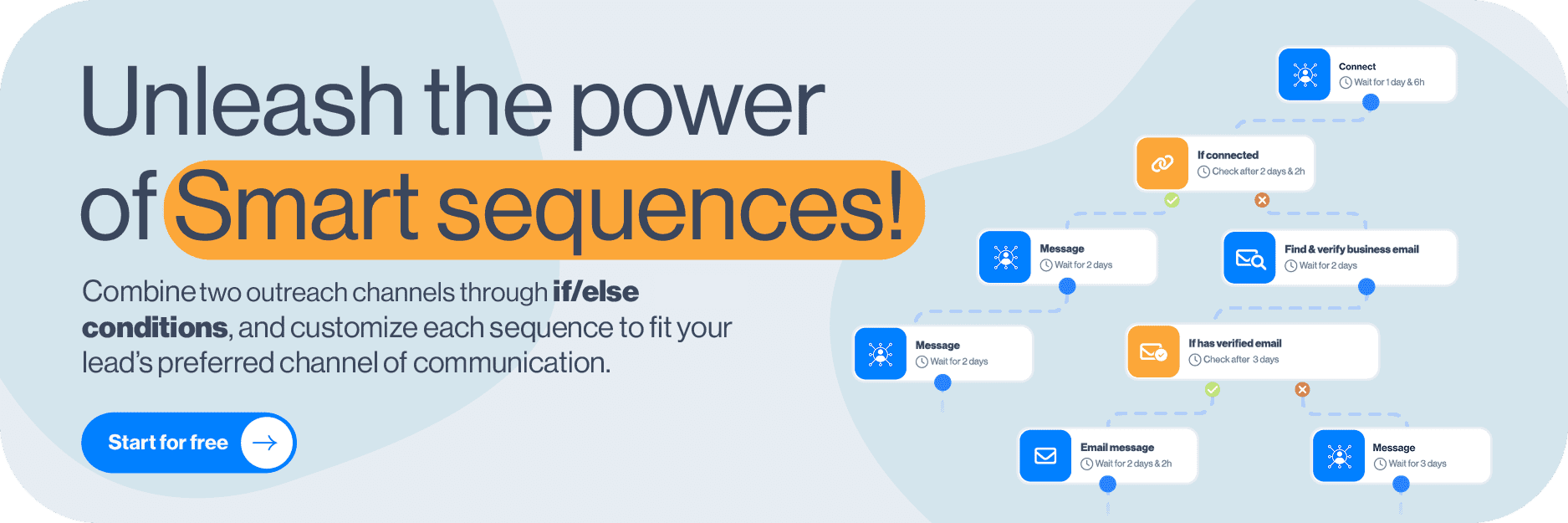
What makes Skylead’s Smart sequences special is that you can combine email and LinkedIn automation with if/else conditions. This will help you get to your prospects one way or the other while maximizing touchpoints with leads. You can use all Skylead prime features inside these sequences to help with a more streamlined outreach. This includes:
- AI data enrichment - allows you to add more data to your contacts and company lists, auto-create personalized messages, and boost your response rates.
- Account based prospecting - Helps you create focused company lists, find matching contacts
- Email finder & verifier - Helps you find your leads’ double-verified business emails without breaking the outreach flow, at no extra cost, and with no 3rd party tools.
- Image & GIF personalization - Adds an extra visual touch to your outreach, making each message tailored to your leads’ interests and personal information. Plus, it increases the response rate.
- A/B testing - You can test up to 5 variants of copy to determine which approach works best for which leads.
Now, let’s create a campaign together to see how it works. It's as easy as 1, 2, 3…
Skylead Smart sequences
1. First, click the “Create new campaign” button.
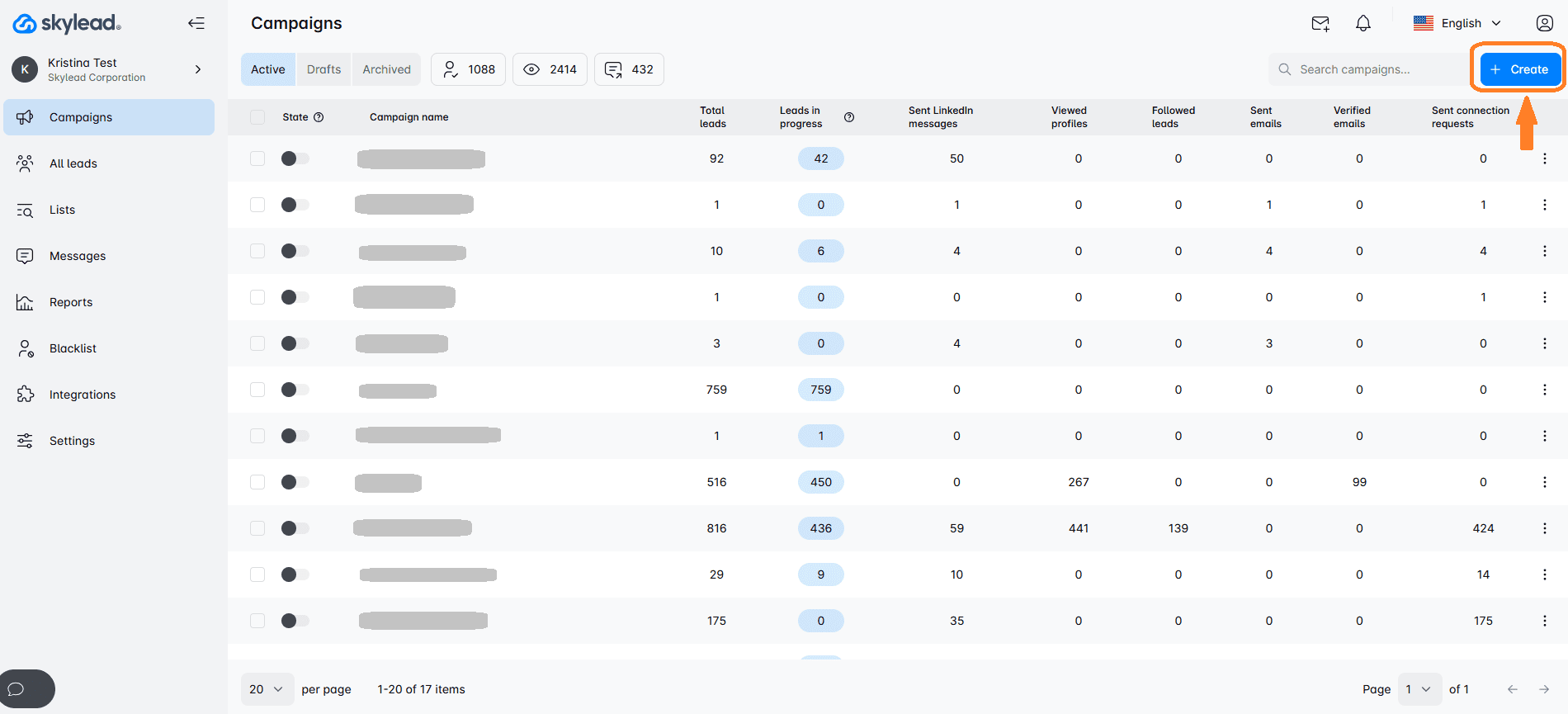
2. Second, add or create your lead list and adjust your outreach settings and hit Next to create a sequence.
To create a smart outreach sequence, drag and drop the desired actions and conditions and create a coherent outreach flow. Here’s what a simple smart sequence looks like ?
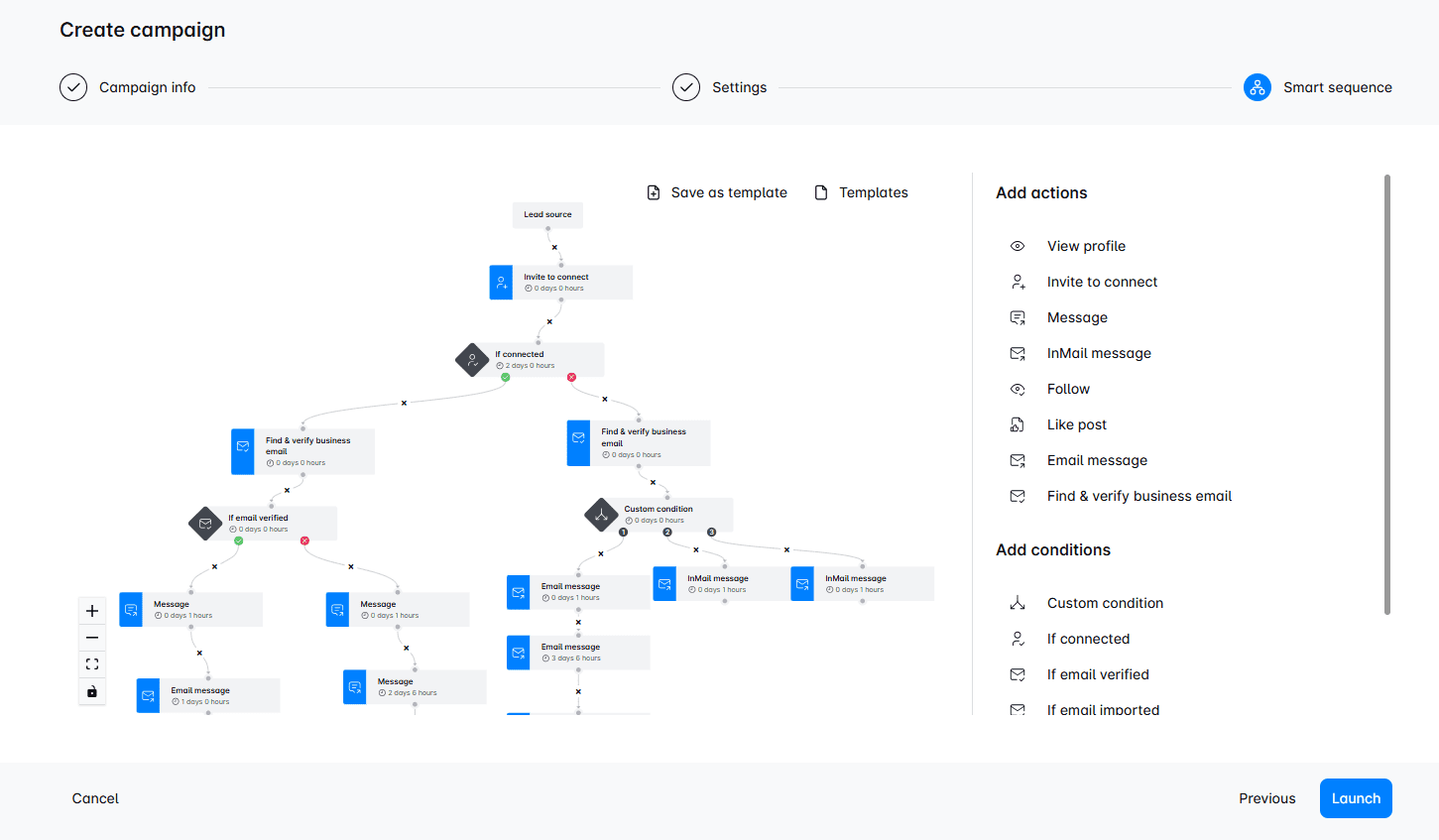
Now that you have a tool that does all this, plus a little bit more, you’re one step closer to building one of the best outreach sequences out there. But before you start creating your outreach flow, let’s look at sequence message types and review tested and proven sequence examples.
5 Types of sequence messages with examples
1. Educating Messages
When talking to prospects who are still not ready to buy, register, or become clients, you can create and send educating messages. These messages aim to help prospects learn about your product/service and show them how your product can fix their pain points and challenges. The goal is to establish trust and encourage leads to take the desired action.
Here’s an example of a LinkedIn and email educating message:
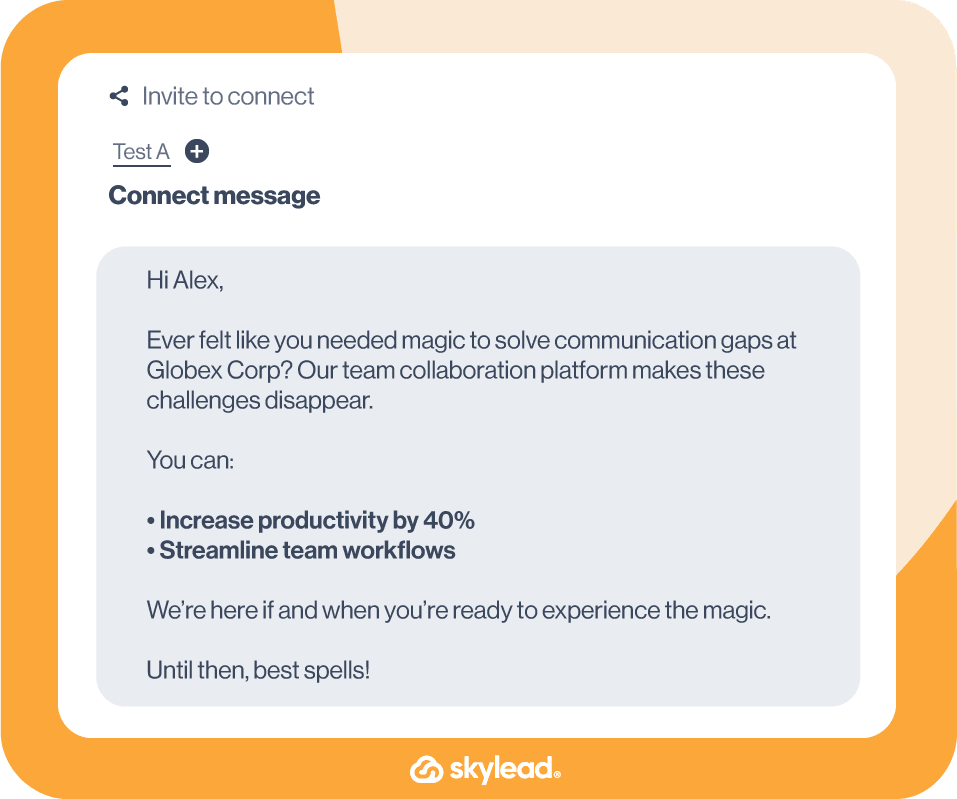
LinkedIn connection request
Hi {{firstName}},
Ever felt like you needed magic to solve {{painPoint}} at {{Company}}? ✨
{{product/service}} makes these challenges disappear.
You can:
1. Increase {{metric}} by {{number}}%
2. {{benefit}}
We’re here if and when you’re ready to experience the magic.
Until then, best spells!
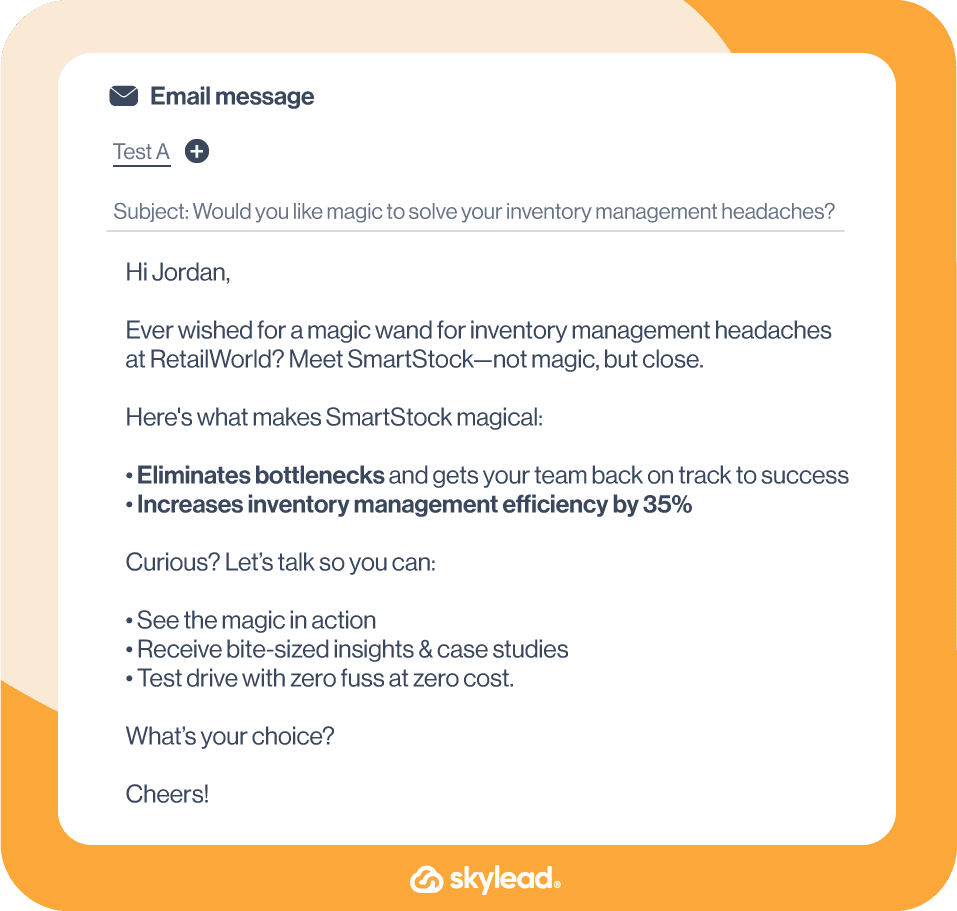
Email message
Subject: Would you like magic to solve your {{painPoint}}? ✨
Hi {{firstName}},
Ever wished for a magic wand for {{painPoint}} at {{companyName}}?
Meet {{solutionName}}—not magic, but close.
Here's what makes {{product/Service}} magical:
1. Eliminates {{painPoint}} and gets your team back on track to success
2. Increases {{metric}} by {{number}}%
Curious? Let’s talk so you can:
- See the magic in action
- Receive bite-sized insights & case studies
- Test-drive with zero fuss at zero cost.
What’s your choice?
Cheers!
2. Messages that build interest
Engagement messages are the most common in cold outreach. Sequences built with engagement messages aim to invoke a reaction from your prospect. Your goal with these messages should be to keep them engaged and get them to build interest in your product/service gradually.
Here’s an example of a LinkedIn and email messages that build interest:
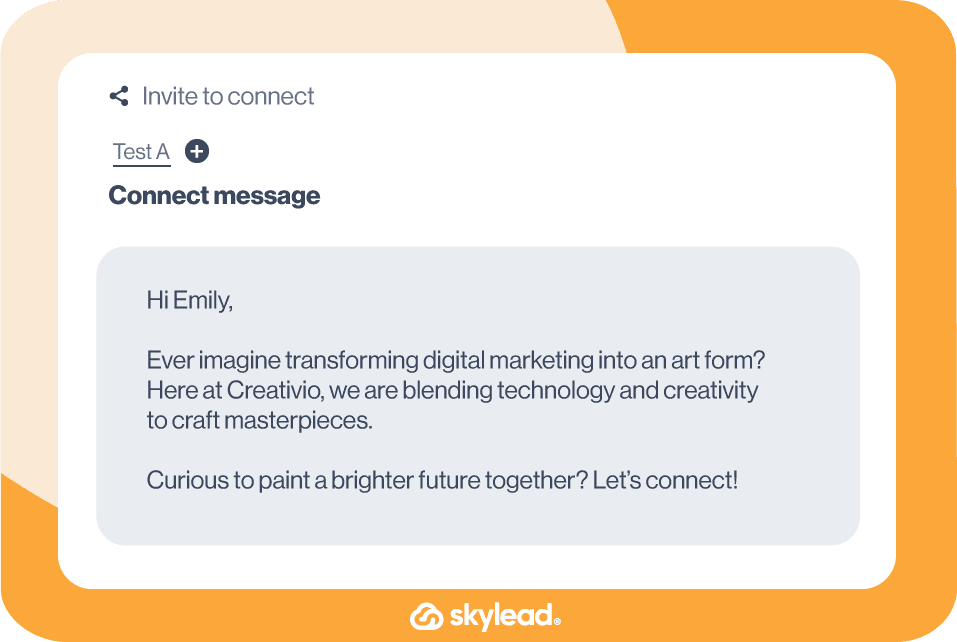
LinkedIn connection request
Hi {{firstName}},
Ever imagine transforming {{challenge}} into an art form?
Here at {{product/Service}}, we are blending technology and creativity to craft masterpieces.
Curious to paint a brighter future together? Let’s connect!
Email message
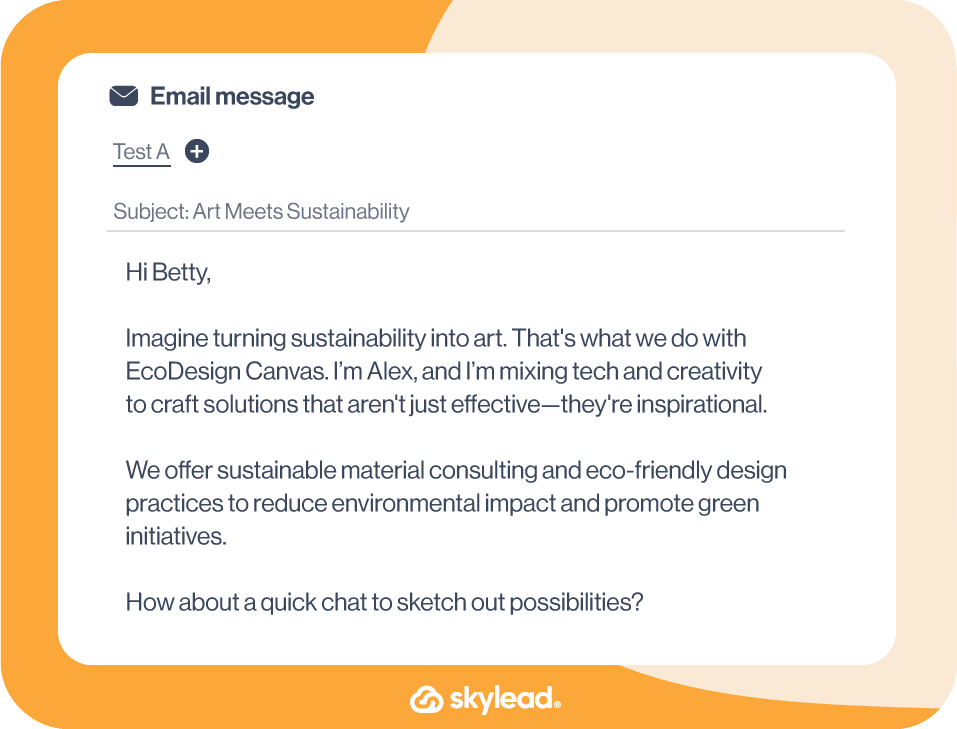
Subject: Art Meets {{challenge}} ?
Hi {{firstName}},
Imagine turning {{challenge}} into art. That's what we do with {{product/Service}}. I’m {{yourName}}, and I’m mixing tech and creativity to craft solutions that aren't just effective—they're inspirational.
We offer {{solution1}} and {{solution2}} to {{benefit}}.
How about a quick chat to sketch out possibilities?
3. Competitor analysis messages
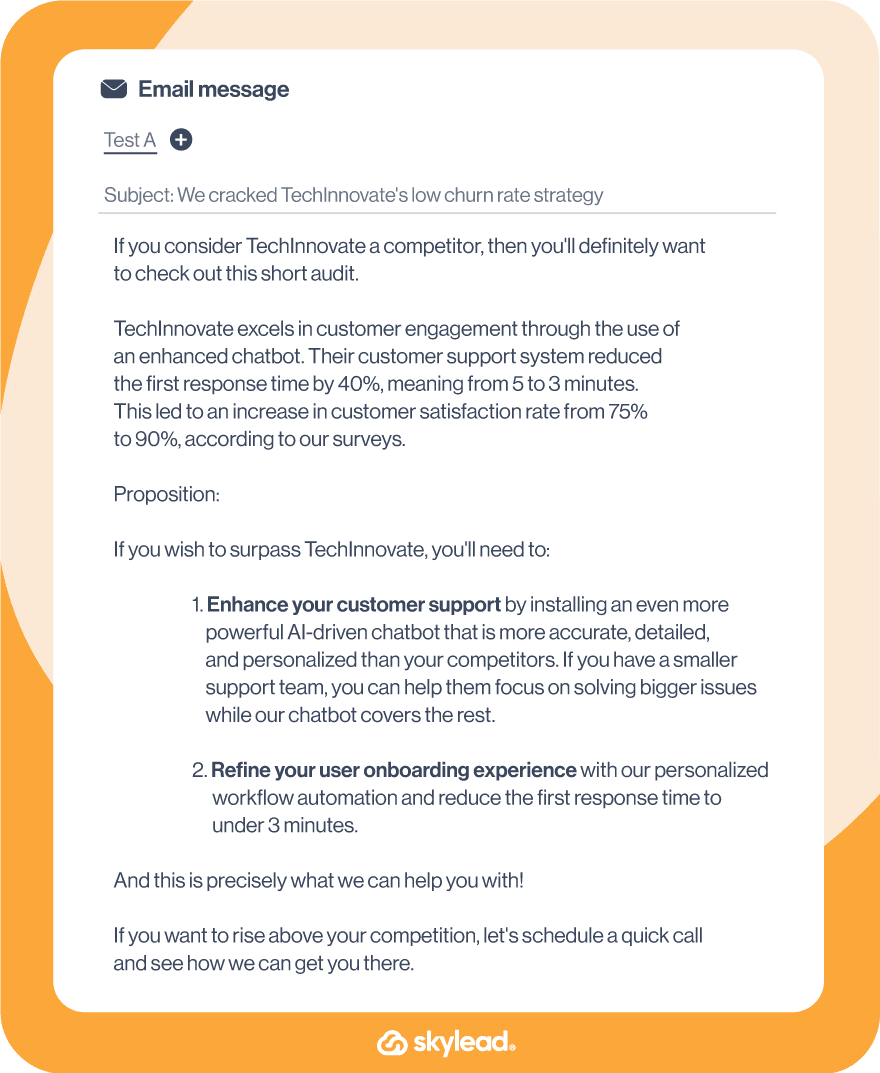
If you plan to talk about the competition, the trick is to give them a simple competitor analysis and show them how they’re getting these results. Then, emphasize how your product/service can help achieve said benefits. Then finish off with a simple and clear CTA that leads the prospect to a particular action, like scheduling a meeting, booking a call, sending a demo link, etc.
Here’s an example of a LinkedIn and email competitor analysis message:
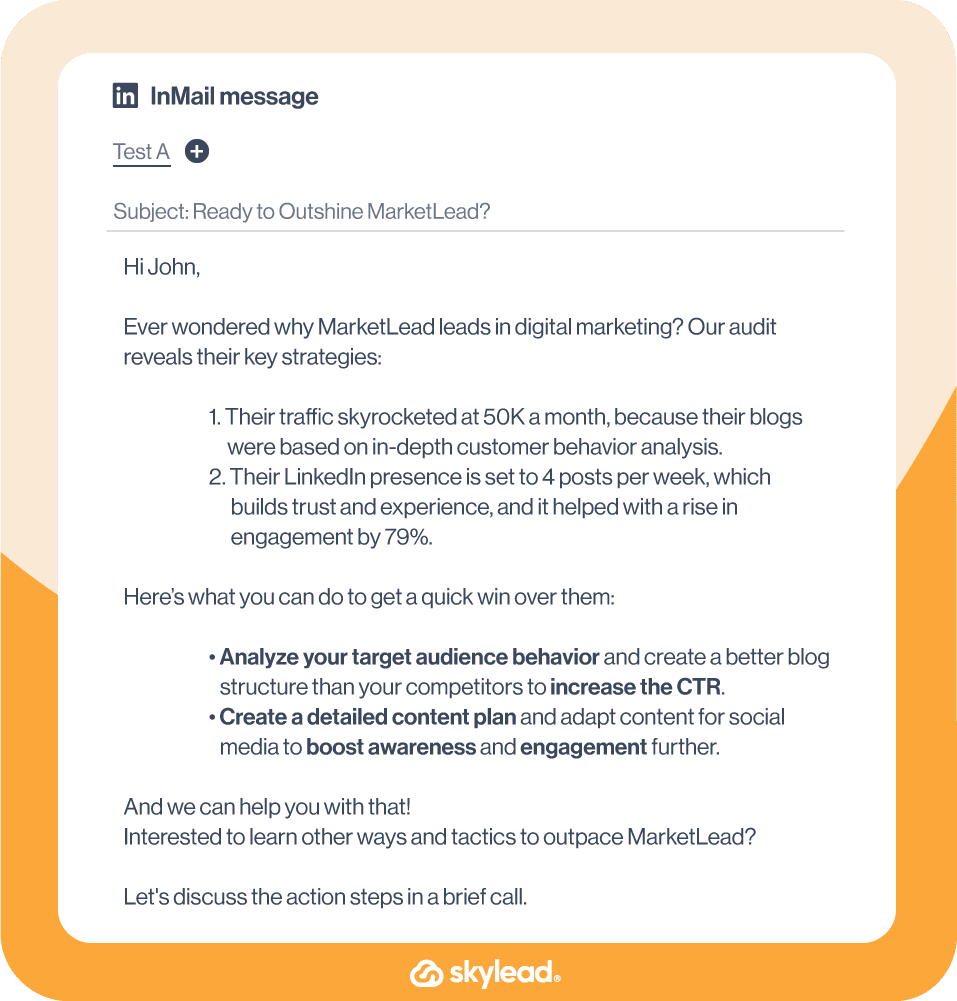
LinkedIn InMail message
Subject: Ready to Outshine {{competitorTool}}? ?
Hi {{firstName}},
Ever wondered why {{competitorName}} leads in {{industry}}? Our audit reveals their key strategies:
{{Describe their approach to key strategy 1}}.
{{Describe their excellence in key strategy 2}}.
Here’s what you can do to get a quick win over them:
{{Your Offer - Task 1}} to elevate your {{result}}.
{{Your Offer - Task 2}} to boost {{specific outcome}}.
Interested in outpacing {{competitorName}}?
Let's discuss actionable insights in a brief call.
Email message
Subject: We cracked {{competitorName}} {{industry}} strategy ?
If you consider {{competitorName}} a competitor, then you'll definitely want to check out this short audit.
{{Analyze competitor's publicly available workflows or strategies and emphasize what they are doing right.}}
Proposition:
If you wish to surpass competitor name and get a bigger market share, you'll need to:
{{fWhat you offer - task 1}}
{{fWhat you offer - task 2}}
And this is precisely what we can help you with!
If you want to rise above your competition, let's schedule a quick call and see how we can get you there.
4. Follow-up messages
If your prospect didn’t respond to your first message, all you need is a follow-up. A follow-up is a crucial part of an outreach sequence, and it’s necessary in order to give your prospect a gentle reminder of your existence and to lead them further down the buyer’s journey.
The goal is to keep in touch with your prospects and give them the right kind of motivation to respond to you.
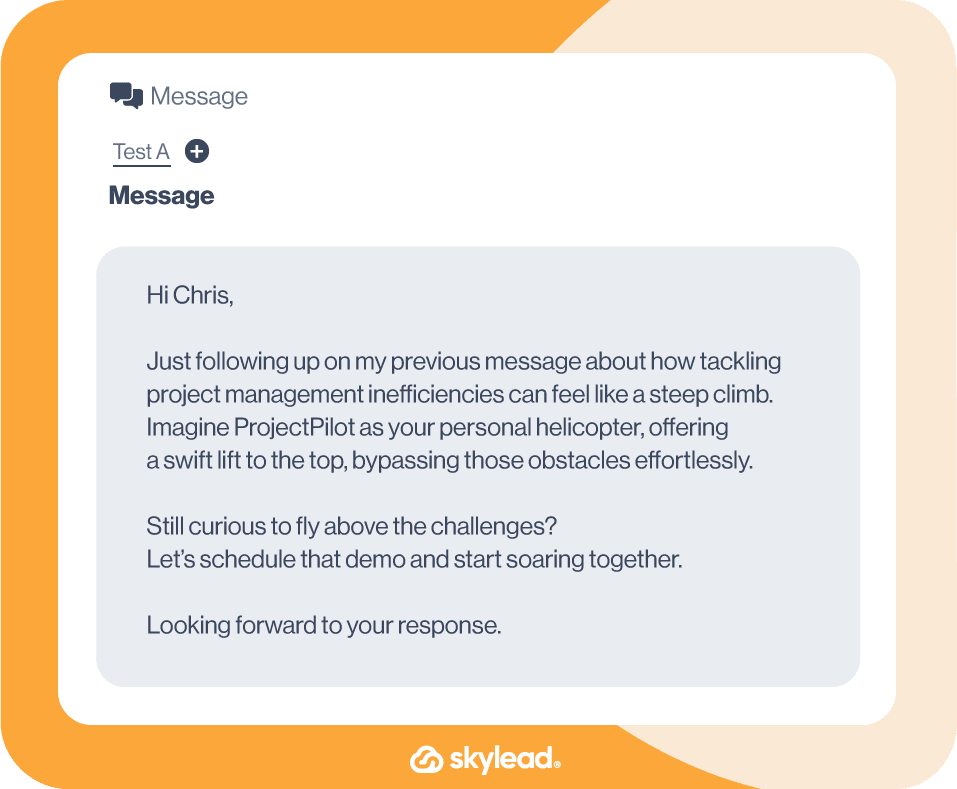
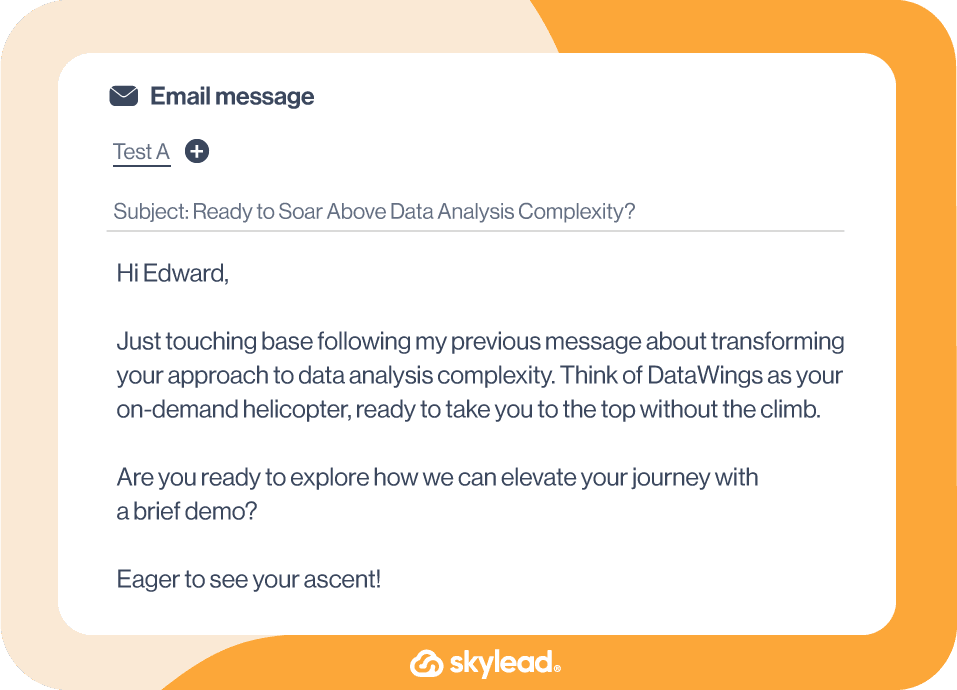
Here’s an example of a LinkedIn and email follow-up message:
LinkedIn message
Hi {{firstName}},
Just following up on my previous message about how tackling {{challenge}} can feel like a steep climb. Imagine {{product/service}} as your personal helicopter, offering a swift lift to the top, bypassing those obstacles effortlessly.
Still curious to fly above the challenges? Let’s schedule that demo and start soaring together.
Looking forward to your response.
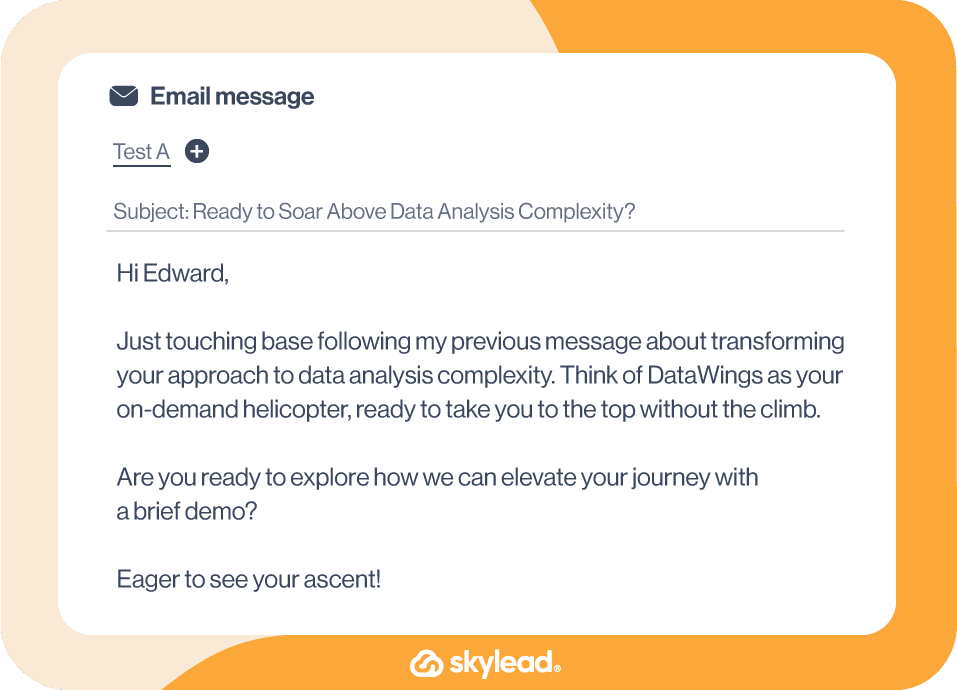
Email message
Subject: Ready to Soar Above {{challenge}}? ?
Hi {{firstName}},
Just touching base following my previous message about transforming your approach to {{challenge}}. Think of {{product/service}} as your on-demand helicopter, ready to take you to the top without the climb.
Are you ready to explore how we can elevate your journey with a brief demo?
Eager to see your ascent!
5. Re-engagement messages
Sometimes, prospects lose interest, change their email addresses or they would like to revisit your conversation in a few months. In these cases, you can do two things: in the first, send a re-engagement message to restart the conversation. In the second case, use Skylead’s Find & verify business email feature to get to your prospect's new email address and then send the re-engagement message. Convenient, right?
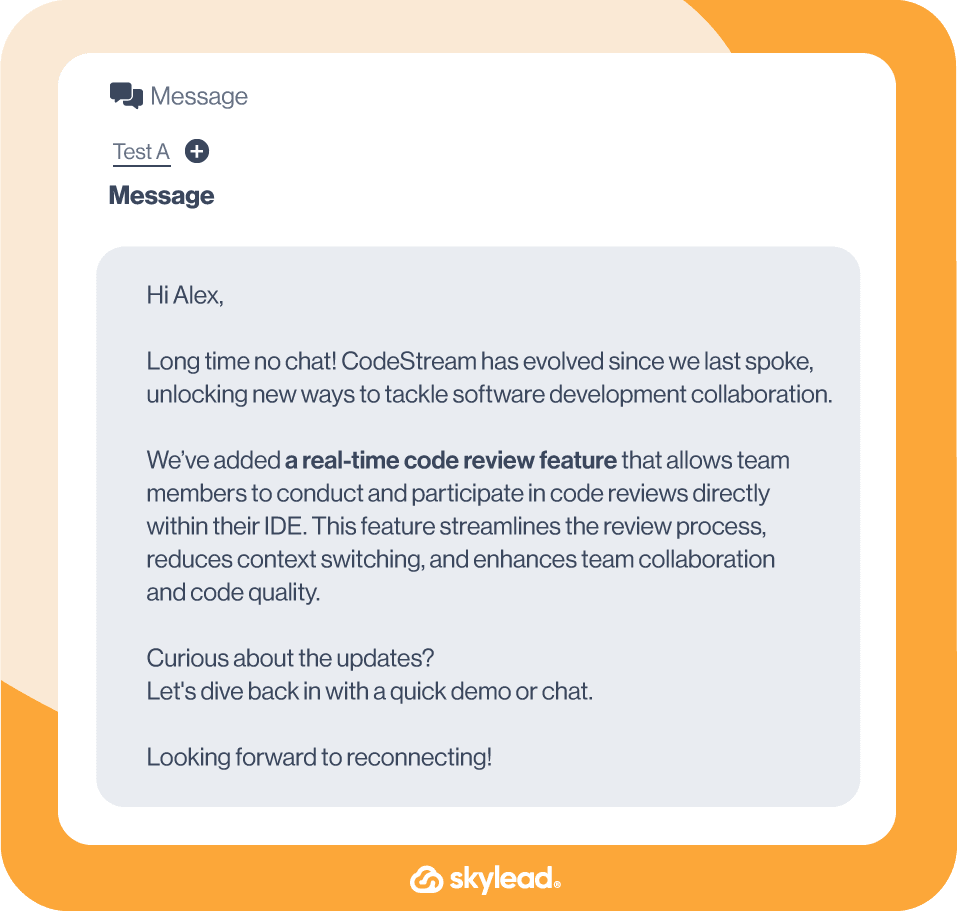
Here’s an example of a LinkedIn and email re-engagement messages:
LinkedIn message
Hi {{firstName}},
Long time no chat! ?️ {{product/Service}} has evolved since we last spoke, unlocking new ways to tackle {{challenge}}.
Curious about the updates? Let's dive back in with a quick demo or chat.
Looking forward to reconnecting!
Email message
Subject: A lot has changed at {{product/Service}}! Let’s catch up ☕
Hi {{firstName}},
It's been a while! Since our last conversation, {{product/Service}} has grown, offering new {{benefit}} for {{challenge}}.
Up for a brief update? A quick chat or demo could spark new ideas.
Best outreach sequence examples
Enough theory. Let’s get to the actual social proof – a section where we show you our best outreach sequences that have been tested and optimized to perfection to produce great outreach results.
Given that we believe that multichannel outreach is the way to go, we’ll show you 4 of our sequence templates, which are sure to bring results. All you need to know about them is that our Head of sales, Andrea, closed 50+ meetings while using them! ✨
1. Reach out to leads who reacted to a LinkedIn post of an industry expert
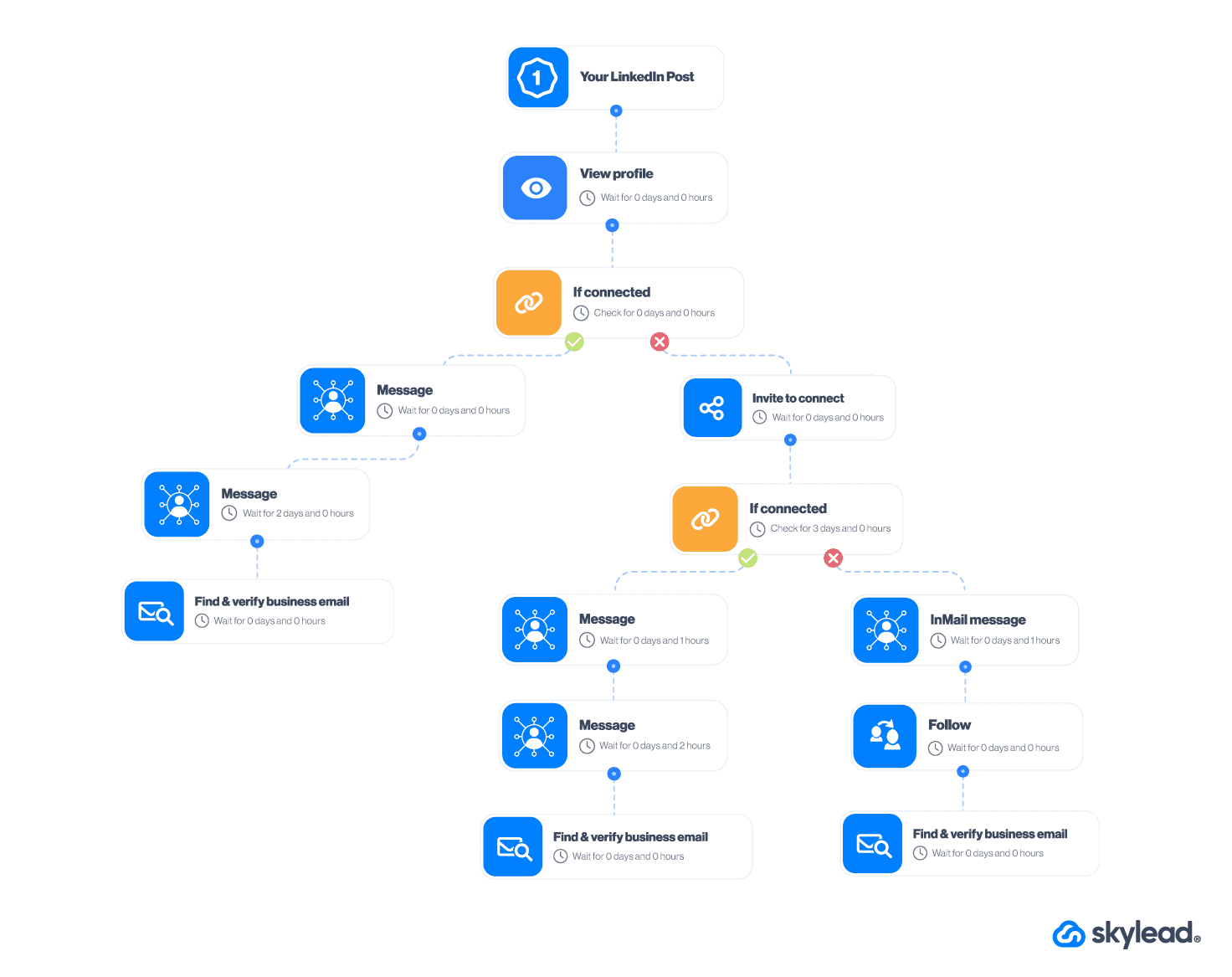
In this outreach sequence, we’ve used a combination of educational and conversion messages. Let’s look at the stats:
- 76% acceptance rate
- 35% reply rate
- 85% open rate
The sequence works because we used both LinkedIn and email and exhausted all communication channels to get to our prospects in any case. If you’re trying to reach people who reacted to someone’s LinkedIn post, the presumption is that you’re probably not connected to them.
We’re using InMails because, from our experience, people generally respond better to them. If you can send them for free, without spending your InMail credit, even better. The Find & verify email feature is here to reach prospects by email if they’re not as responsive on LinkedIn. Email is important in outreach. In fact, 77% of B2B buyers prefer to be contacted by email.
2. Target specific group members

This particular sequence landed many new users, and our sales team got to book more meetings than usual. We’ve used follow-up, engagement, and conversion messages and utilized both communication channels. Here are the results:
- 53% acceptance rate
- 27% reply rate
- 73% open rate
Targeting specific group members means that we are looking for decision-makers and we want to reach them faster. You can do this by using Sales Navigator search results with the Group members filter. In the sequence we’re using the If connected condition for LinkedIn to cover all leads from our lead source. Then, if they’re not responsive on LinkedIn, we find their double-verified email address and try reaching them there.
3. Approach people who checked out your website
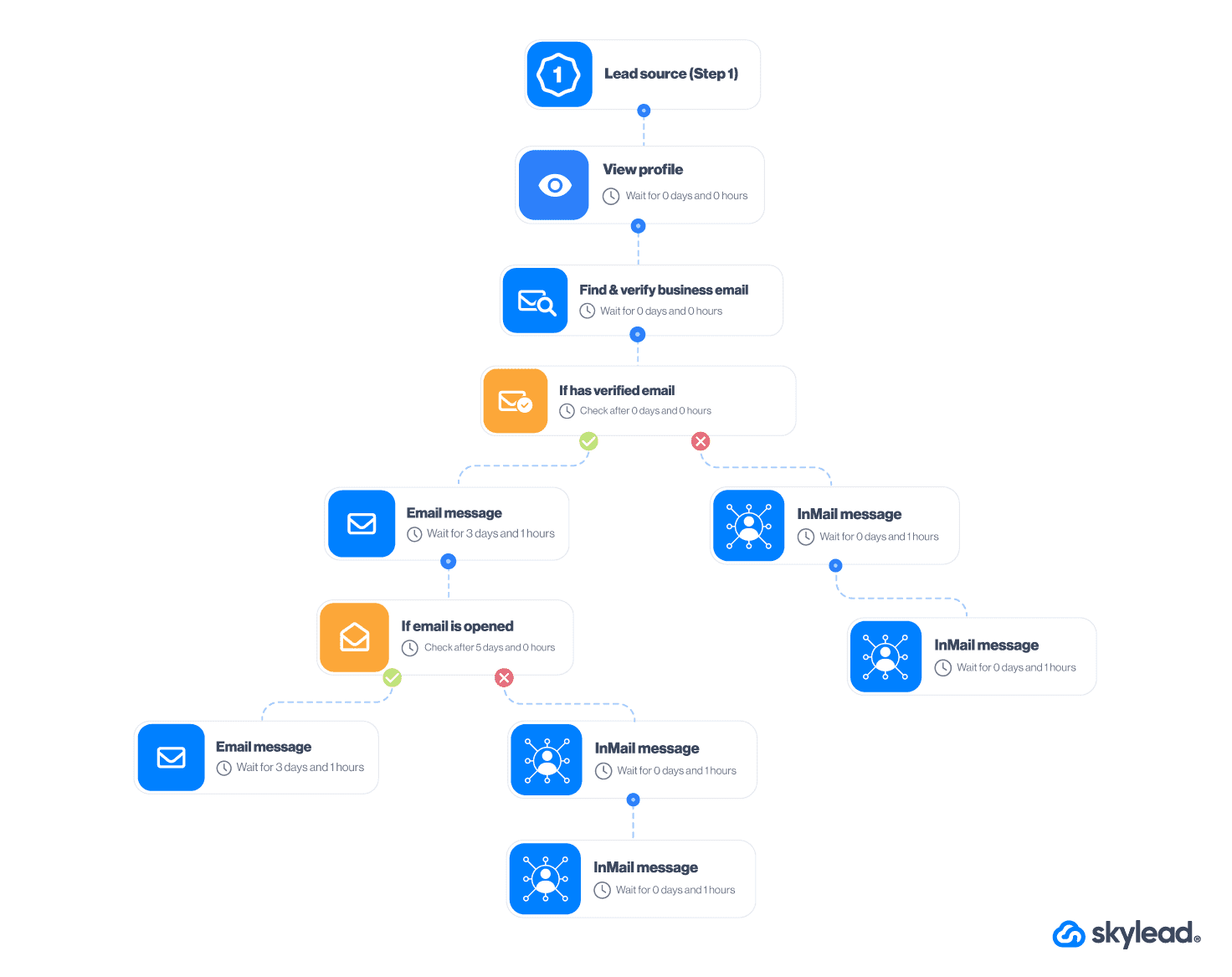
Marketers, behold! A sequence that will target people who stumbled upon your website and need a little nudge to take action. If you're using a 3rd party tool on your website that can tell you what company visited your website, you can easily find those people on LinkedIn and reach out. Let’s get right into the stats:
- 43% acceptance rate
- 23% reply rate
- 71% open rate
In this sequence, our sales team used educational and engagement messages to spark additional interest and give social proof and more information to prospects already interested in your product/service. We also opted for a multichannel approach that works every time!
4. Educational sequence with a focus on email
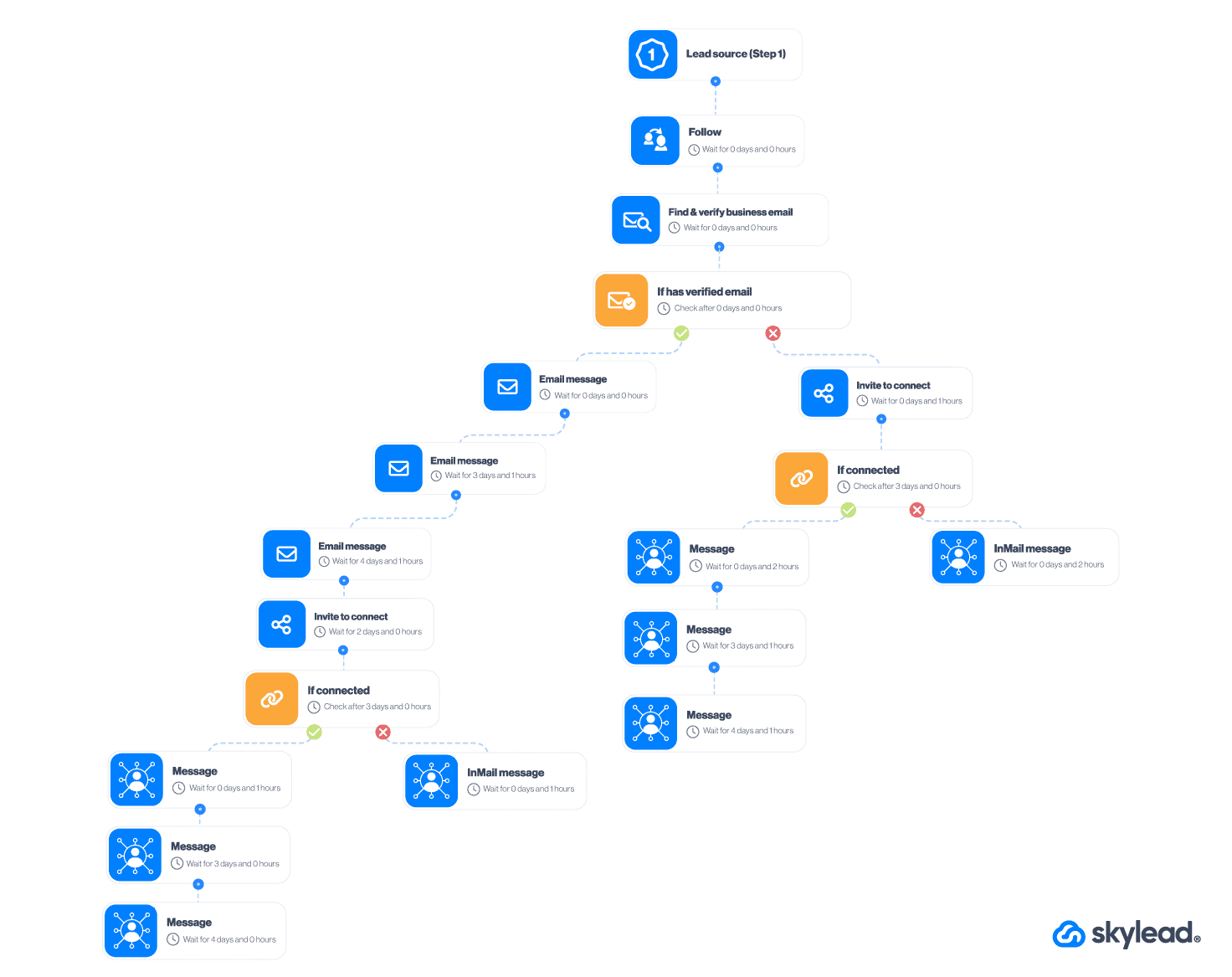
This sequence is part of our free trial period and is also available to all Skylead users. Our sales team made this template to show you how to engage with your target audience and get them hooked to your product/service with carefully crafted messaging and tone.
We’ve used educational and engagement message types, focusing on email, but also using LinkedIn as the other communication channel. Here are the stats:
- 63% acceptance rate
- 41% response rate
To see template messages, you need to register for a 7-day free trial with Skylead.
Outreach sequences: Best practices
After testing and experimenting with different approaches, we’ve formed a list of best practices we always keep in mind when creating outreach sequences. Let our experience serve as a guide for you to create the best outreach sequences. ?
Use a multichannel approach
What if we told you that 58% of people check their emails first thing, and14% check social media? This statistic just proves that using two or more communication channels is a must in outreach. We’ve said it once and will say it again: the multichannel approach is the best way to go for higher response rates and faster overall results.
Automate outreach
Businesses that automate outreach campaigns can improve their response rate by a whopping 250%. If your goals are reaching a larger audience or you just want to save time on manual outreach and focus on building and nurturing relationships with prospects, outreach automation is the best solution for you. Plus, a great perk is faster and better results, too. ?
Add a catchy subject line
Did you know that creating a catchy subject line is directly linked to a higher open rate? A good subject line combined with pre-header text is what helps prospects decide whether they will open and read your email.
Our best advice would be to keep it short, simple, and around 55-60 characters (under 30 characters if you want to stand out in mobile inboxes). Regarding emojis, our research suggests that you should use 1 emoji per subject line. Also, do not put emojis instead of words to avoid confusion.
Personalization
In this day and age, if you want to stand out online, you need to personalize your approach. If you create tailored messages, emails, and follow-ups and then add visual elements to the mix (Skylead’s Image & GIF personalization), you’ll surely get a higher response rate. In fact, up to 63%, to be exact.
Keep it short
No prospect wants to read a huge message with a standardized template approach. If you plan on creating an effective outreach sequence, you need to be concise and to the point. Otherwise, your message will get lost in your prospects’ inboxes with no trace.
However, if you don’t get a yes the first time around, creating a strong follow-up message after no response can up your chances of success. In this case, the same rules apply - keep your messages short, but with each one, add more value and personalized elements.
Relevant value proposition
Each message you craft and send in an outreach sequence should bring value to your prospect. Once you gather information about your target audience, make sure to find relevant touchpoints and spread them evenly across your sequence. With each message, there needs to be more value. You need to tell your prospects that your offer is precisely what they need.
Pro tip: Andrea, our Head of sales, says that in sales emails, it’s never about you. It’s about the prospect and their problems that can be solved only with your solution and your solution.
Include social proof
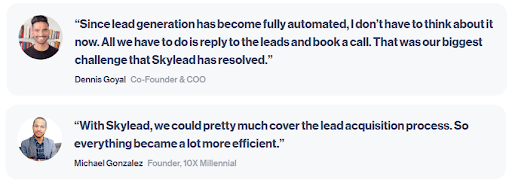
In outreach, it’s all a numbers game. This means that adding certain bits of proven information, results, or statistics will spark more interest with prospects. Link a case study, or add 1 or 2 sentences to your outreach message to add social proof to your outreach.
Call-to-action (CTA)
Our sales team told us to tell you that when creating calls to action, you need to think about creating the perfect environment for your prospect to take the desired action. Naturally, your entire message should build up to this closing moment, the so-called CTA. To avoid confusion, use just one prompt instead of a couple. Keep their focus through the message body and then add the CTA.
From our experience, a good CTA should be:
- simple
- straightforward
- clear
Determine the timeframe of the sequence
In outreach, as in life, timing is everything. Determining the duration and the spacing between messages is equally important as the messages. If you send messages too often, they’ll be considered spam, but the sequence won't be successful if you don’t contact them often enough. It’s all about balance, so make sure to space out your outreach messages anywhere from the standard 2 to 5 business days.
A/B testing for optimization
Not sure if your content is good enough? No worries. A/B testing, also known as split testing, is here to help with constant campaign improvement. We advise you to incorporate frequent A/B tests into your outreach sequence strategy to get better results faster. Make it a habit to always look into better ways of reaching out to prospects.
Frequently asked questions
How does one tailor outreach sequences for different industries, such as tech versus healthcare, to ensure relevance and higher engagement rates?
Tailoring outreach sequences for different industries involves researching industry-specific pain points, language, and trends. For tech, emphasize innovation and efficiency; for healthcare, focus on compliance, patient care, and privacy. Customization increases relevance and engagement by addressing specific needs and interests of the target audience.
Can the effectiveness of an outreach sequence vary by geographical region, and if so, what adjustments should be made to cater to different cultural preferences?
The effectiveness of outreach sequences can indeed vary by geographical region due to cultural and time differences. To adjust, incorporate local time, business etiquette, language nuances, and cultural norms. Understanding regional communication preferences and holidays can also enhance the personalization and effectiveness of the outreach.
What are the long-term impacts of using these outreach sequences on brand reputation and customer relationships, especially in cases where recipients might perceive the outreach as spammy?
Long-term impacts of using outreach sequences on brand reputation and customer relationships depend on execution. If perceived as spammy, it can harm reputation and deter potential customers. Conversely, value-drive, personalized outreach can enhance brand perception, foster trust, and build lasting relationships, highlighting the importance of customization and relevance.
Ready to put these best outreach sequences to use?
Of course you are! Now that we covered everything you need to know about creating the best outreach sequences, it’s safe to say that if you follow these instructions, you are well on your way to success with your outreach efforts. So, let’s review what we’ve learned so far:
- Using automation tools in outreach saves time, boosts results, and gives you more time to focus on building better sequences and nurturing relationships with leads.
- Using a multichannel approach, which means two or more communication channels, is key to a faster and more effective outreach.
- Personalization is the key to higher response rates.
- Catchy subject lines are directly related to higher open rates.
- A clear CTA leads to better click-through and response rates.
- Strategic timing in outreach sequences improves overall results and affects all relevant metrics.
- By combining relevant content with personalized communication, we build trust and interest.
So, what’s the next step? Well, all you need now is the right automation tool to assist you in creating the best outreach sequences and building successful campaigns that bring jaw-dropping results. This is where Skylead comes to the rescue. You can register for free, start your 7-day free trial, and begin creating the best outreach sequences out there! Let the outreach begin! ?
Updated on: September 15th, 2026
Disclaimer: Skylead is not affiliated, endorsed by, or connected with LinkedIn in any way.
Spread the word about your product or service to as many people as you can, and you’ll surely get someone to buy it. That may be true, but think about how much time and resources you’d spend in the process. Precision matters in outreach as much as it does in everything else in business and life. And that’s what targeted outreach is all about.
Targeted outreach helps you connect with people and businesses that need your product or service only—the same ones that can increase your return on investment (ROI) and conversion rates.
The question is, how do you make it work for you?
That said, in this blog, we’ll be covering:
- What targeted outreach is,
- Who and how can benefit from it,
- How to plan and execute a targeted outreach campaign,
- Actionable strategies and best practices for targeted outreach,
- Common challenges you may encounter.
As a bonus, you'll get message templates to immediately transform your outreach strategy from a shot in the dark to a laser-focused one.
Off we go!
What is targeted outreach?
Targeted outreach is a type of outreach that focuses on engaging specific, predefined groups or individuals. It implies delivering tailored messages, resources, or services that align closely with the needs, interests, and behaviors of these targeted audiences.
While traditional outreach employs a broad, one-size-fits-all strategy, targeted outreach is more nuanced. Namely, it uses detailed data and insights to not only identify the target audience but also understand them. In contrast to traditional outreach, which relies on mass communication channels and broad demographic information, targeted outreach is all about relevancy and personalization.
Benefits of targeted outreach
Blasting your message to everyone and anyone might get you a few bites. However, targeting your outreach is a much smarter, more efficient way to connect with leads. It's a tactic sales professionals, marketing specialists, and B2B founders, in particular, stand to gain a lot from.
But the question is, what?
Firstly, one of the primary benefits of targeted outreach is superior LinkedIn lead generation and that on other platforms.
When you are precise about who you’re targeting and why, the results are higher-quality leads. Moreover, when you aren’t wasting your time chasing irrelevant prospects, you can afford to spend more time nurturing those more likely to convert.
Then, there’s better brand awareness and recognition.
When messages are tailored to resonate with specific audiences, they are more likely to be noticed and remembered. This relevance makes the outreach more effective and also helps in building a stronger connection with prospects. Over time, this leads to increased brand loyalty but also a more substantial presence in the market.
However, increased conversion rates and a higher return on investment (ROI) are perhaps the most compelling benefits of targeted outreach.
Targeted campaigns are more likely to generate returns, as the goal of this strategy is to minimize wasting efforts on uninterested parties. This fact alone is precisely whytargeted outreach strategies are some of the mostcost-effective sales and marketing strategies.
How to plan your targeted outreach campaign
Looking to jump on the targeted outreach wagon?
Congrats! That said, let’s see how you can prepare and launch one such campaign.
Targeted outreach preparation
1. Define your target audience
The first and arguably most important step in planning your targeted outreach campaign is defining your target audience. After all, without knowing who you're talking to, your message is likely to miss the mark.
So, how do you pinpoint your ideal audience?
Start by identifying your Ideal Customer Profile (ICP).
Your ICP represents the type of company or individual who would most benefit from your product or service.
To define it, consider factors like:
- Industry
- Company size
- Location
- Challenges they face
For example, if you're offering a software solution for project management, your ICP might be mid-sized tech companies in urban areas that struggle with team collaboration.
Once you've nailed down your ICP, it's time to refine it further by creating detailed Buyer Personas.
A Buyer Persona is a semi-fictional representation of your ideal customer in your ideal company. You define it based on market research and real data about your existing customers.
This should include:
- Demographic details—age, gender, education
- Professional information—job title, responsibilities, goals
- Behavioral insights—pain points, decision-making process, preferred communication channels
Combine your ICP with detailed Buyer Personas, and you’ll have a crystal-clear picture of who you should target. Doing so will allow you to tailor your outreach messages accordingly, making them more relevant and compelling to those who receive them.
2. Conduct online research
Now that you know who you should be targeting, it's time to find leads and understand their pain points.
This is where online research comes in handy, with LinkedIn being one of the most valuable tools available.
For most of your research, you’ll rely on LinkedIn search filters to identify key prospects and gather insights.
However, if you are subscribed to Sales Navigator, you might be better off using it for this part of the process.
Why? Because Sales Navigator filters include a total of 34 Lead filters, 16 Account filters, and a Keyword filter.
Arvind Rongala, CEO of Edstellar—a one-stop instructor-led corporate training and coaching solution—explained that Sales Navigator played a big role in the company’s targeted outreach. It helped them define their target audience, which would later result in a 30% increase in lead generation, a 25% rise in sales, and a significant improvement in customer retention.
He mentioned that:
‘’Tools like Google Analytics and LinkedIn Sales Navigator provided valuable insights into the demographics, interests, and behavior of our potential clients.’’
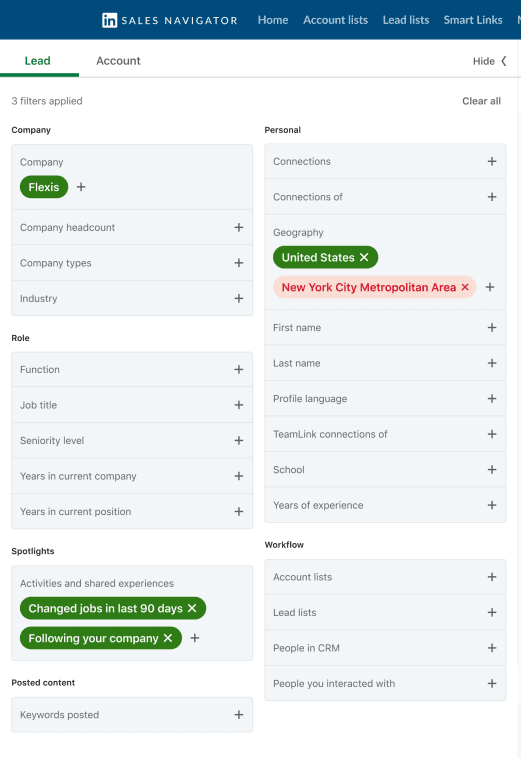
Now, as for researching leads, what you want to do first is use the search bar and filters to look up companies that fit your ICP. Once you have a list of potential companies, explore their LinkedIn pages to gather information about them, check their recent updates, and learn about their company culture.
Then, look for decision-makers within these companies.
Pay attention to their:
- Job titles
- Responsibilities
- Career history
- Posts they published
These can help you understand their roles within the company, but also how your product/service can solve their problems.
Another good place to find and research leads is LinkedIn’s collaborative articles. Think of these as "knowledge topics" filled with real answers submitted by the LinkedIn community.
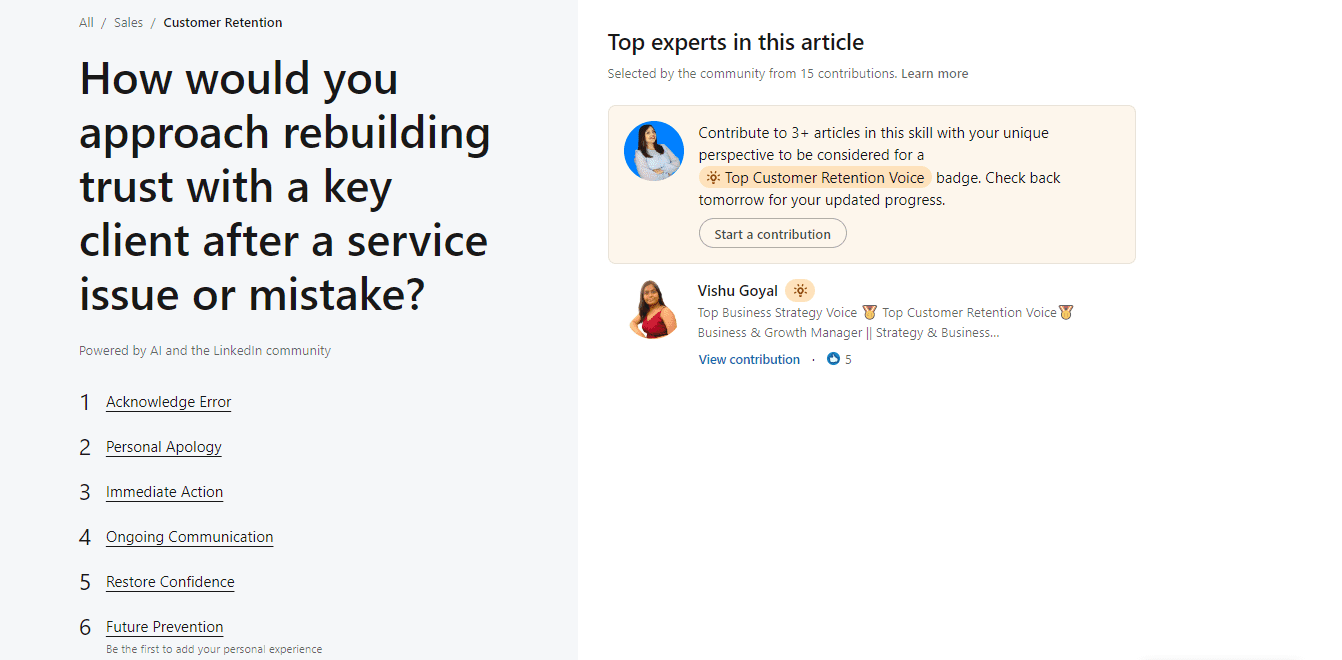
Check if any of your potential leads have contributed to them. If they have, fish for information regarding:
- The topics they are discussing,
- Pain points and interests they have potentially mentioned.
Once done with LinkedIn prospecting, compile the info you gathered into one centralized document.
And if you’ve found your leads through filtered searches, hold onto the URLs. You might need them later.
But more on that in a bit. ?
Targeted outreach execution
1. Develop your message
Planning your targeted outreach efforts is only part of the process, and it’s the execution that matters.
But before you begin reaching out to your target audience, you need to craft messages that your prospects will find intriguing.
As you do, think about what you want to achieve with them.
Are you looking to book more meetings, invite people to join your community, or simply make an introduction?
Either way, your goal should be clear from the get-go. This way, you won’t lose focus, and your messaging will remain direct and to the point.
Don’t be afraid to leverage what you learned during research! Instead, use the information about your prospects’ pain points, interests, and company challenges to craft messages that speak directly to them. Generic messages are easy to ignore. However, a tailored message shows that you've done your homework and makes you stand out in their inboxes.
As for the message itself, start it with a strong, engaging opening. This could be a relevant observation, a question, or a compliment. For instance, if you noticed a company update or a recent achievement on their LinkedIn page, feel free to mention it.
It’s important not to beat around the bush, though.
In fact, aim to deliver your message in a few short paragraphs at most, as busy professionals appreciate brevity.
Also, make sure to avoid jargon and keep your language clear and straightforward.
Here’s an example of a LinkedIn message that follows through on these practices:
‘’Hi Alex,
I noticed on your LinkedIn that you recently attended the Sales Leadership Forum. I came across a report that explores strategies discussed there, particularly around improving forecast accuracy and reducing sales cycle times.
Would you like me to send it to you? I’d love to hear your thoughts !''
2. Choose the right channels
So, you have your message. Now what?
It’s time to decide on the channel to use for targeted outreach.
Email remains one of the most effective ones, with, according to HubSpot, the email open rate ranging from 25% to 41%. As for the average response rate, some sources indicate it's as low as 1%, whereas others report it to be up to 8%.
Apart from email, most professionals who use LinkedIn for B2B marketing or sales use it to reach out to their leads directly. Besides, the average response rate for LinkedIn messages is much higher. For example, we at Skylead had an average response rate of around 39%.
Beyond email and LinkedIn, social media platforms like Facebook and X can also be effective, depending on your audience.
Even the old-fashioned cold-calling might work on some prospects, although success rates can widely range between industries.
However, that begs the question: What channel should you opt for?
We say multiple ones!
A multichannel approach allows you to reach prospects through various touchpoints and, thus, increases your chances of engagement.
This way, you have the highest chance of getting through, even if the prospect is more active on one channel over another.
But more on that in the next section.
3. Create a multichannel targeted outreach campaign
The multichannel route is the best one to take for your targeted outreach. That much we’ve established.
But why engage your prospects through several channels manually when you can do it all on autopilot?
Enter email and LinkedIn automation.
LinkedIn automation implies the use of LinkedIn automation tools to automate repetitive tasks on this platform. These typically include sending connection requests, messages, LinkedIn inMails, profile visits and follows all on autopilot.
But since the premise of multichannel outreach is to use, well, multiple channels, using a LinkedIn automation tool isn’t enough.
You need LinkedIn automation AND cold email software - and our very own Skylead is just what the doctor ordered!
And you know what's great about our tool? You don’t necessarily need to find your leads’ emails yourself. Skylead can discover and double verify emails for you at no additional cost and without breaking your targeted outreach flow or without leads being part of your network.
It also lets you connect an unlimited number of email accounts at no extra cost. In turn, it helps you scale your email outreach by allowing you to send tens of thousands of emails a month.
What's more, you can use it to warm up infinite emails, hyper-personalize your messages with custom images & GIFs, and even find prospects and enrich their data.
Now, let’s walk you through the process of creating a targeted outreach campaign involving LinkedIn and email in Skylead.
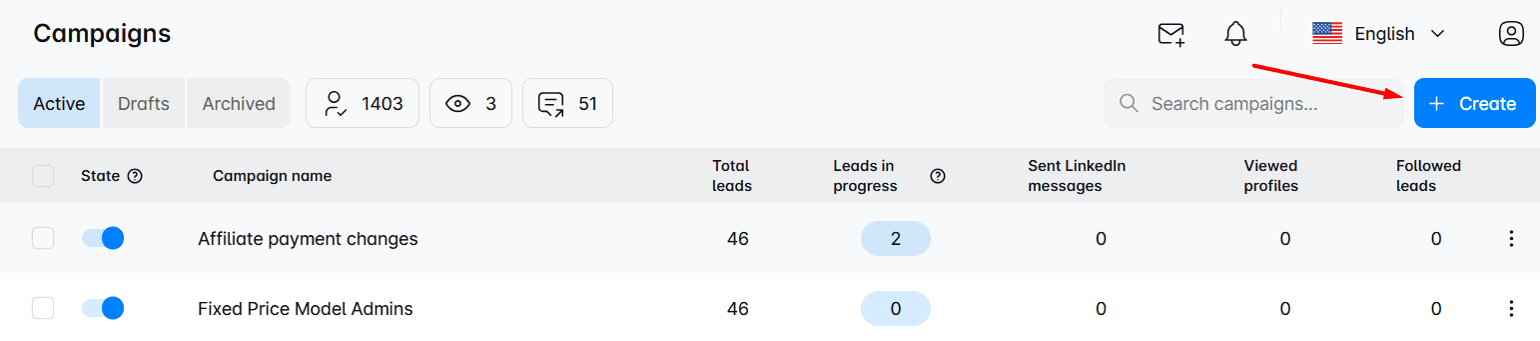
Firstly, go to your Campaigns page and click ‘’Create’’.
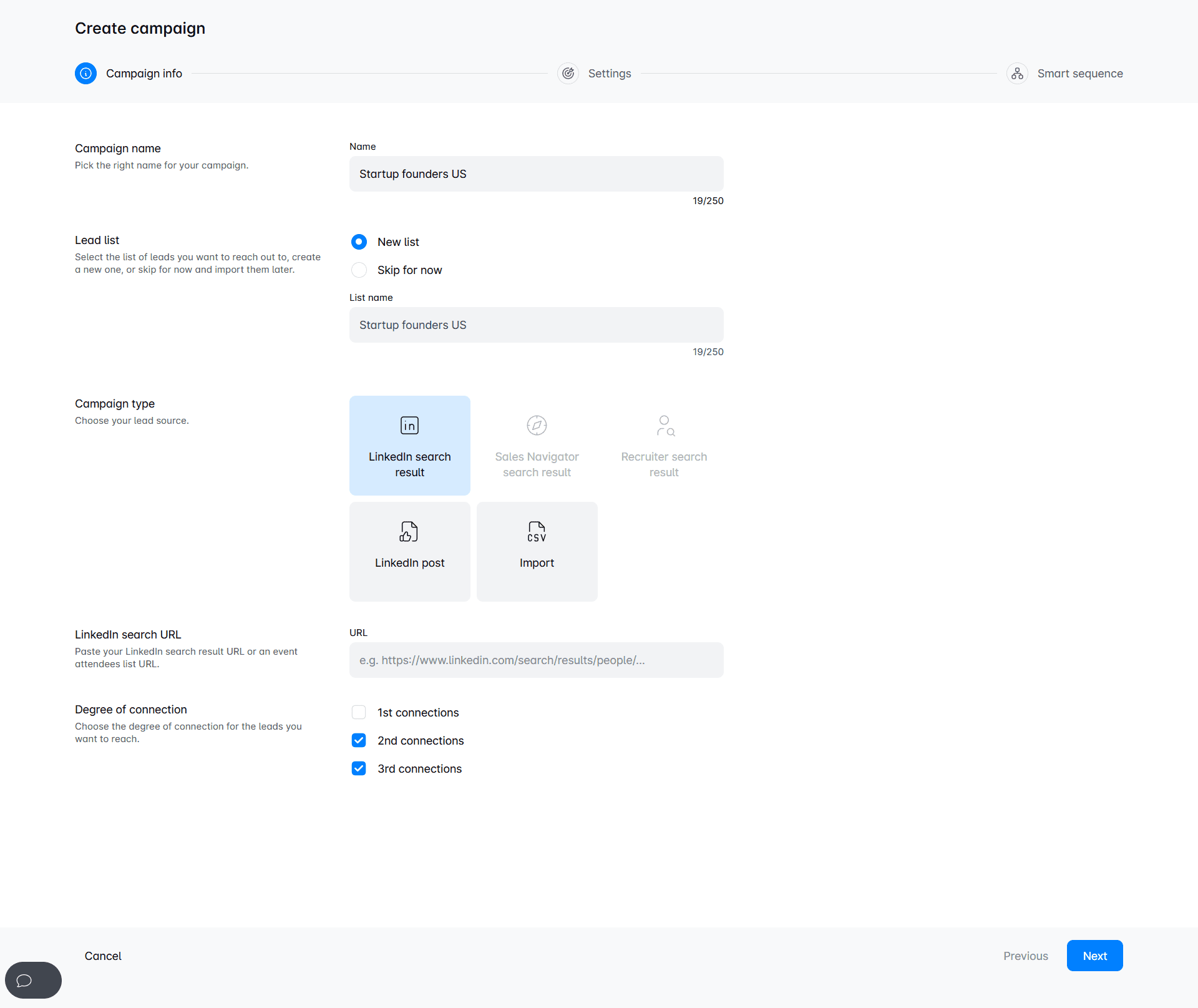
Next, choose your campaign type, name it, and insert the URL you saved while prospecting. Skylead will use it to extract leads.
You can use:
- LinkedIn search, post, and event URL
- Sales Navigator search and lead list URL
- Recruiter search, Talent Pool, and Pipeline URL
You can also import your leads' information into the software directly. In that case, upload a CSV file with precise leads’ information. The tool even allows you to pull in leads from a Lead list you saved. Though this option is relevant only if you previously took the account-based prospecting route, which we explained in detail here.
Finally, choose the connection degree based on whether you want to target your 1st, 2nd, or 3rd-degree connections, and hit ‘’Next.’’
Your next step is defining campaign settings.
Feel free to check out our blog about launching a 1st outreach campaign to learn more about available settings. You can also play around with them on the spot.
Finally, when you're happy with the setup, you can move on to create a sequence.
How to make a targeted outreach sequence
Skylead was the first tool on the market to introduce smart outreach sequences, or as we call them, Smart sequences.
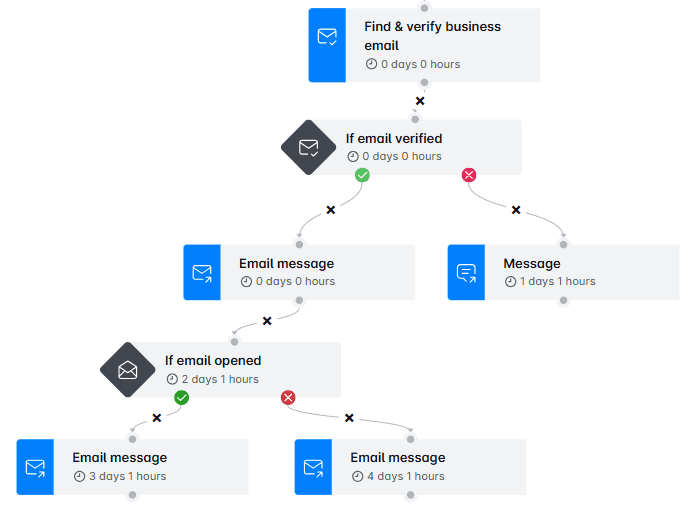
Smart sequences combine if/else conditions with LinkedIn and email actions to create coherent outreach flows. These unfold according to your leads’ behavior and, thus, help you maximize touchpoints with them.
For instance, you can start with a LinkedIn connection message and move on to email if the prospect isn’t responsive. Nonetheless, if neither proves fruitful, you can always go back to LinkedIn and try your luck with an InMail.
To create one, simply drag and drop the elements, a.k.a. actions and conditions, into the open space and connect them in a coherent outreach flow.
This is what one Smart sequence can look like.
You can also personalize messages by inserting pre-set variables (merge fields) or create your own. What's more, you can perform A/B testing of up to 5 different message variants.
Additionally, you can insert an image or GIF into your message and personalize it to each recipient for added flair.
Once you’re happy with the sequence and your messaging, you can save the sequence as a template. Then, hit the ‘’Launch’’ button and watch your targeted outreach efforts come to fruition!
Actionable strategies and best practices for targeted outreach
Want to maximize the effectiveness of your targeted outreach?
If so, use the following strategies and best practices to connect with your leads on a deeper level and give your conversion rates a boost!
1. Personalize, personalize, personalize
As we’ve already established, personalization is the backbone of targeted outreach.
When you take the time to customize your messages, recipients feel more valued and understood. This can significantly boost response rates.
Start by using their name in your communication and referencing specific details you previously learned.
Here’s an example of a personalized outreach message:
‘’Hi Sarah,
Seeing as your focus is on customer engagement at Innovate Marketing, I thought you might appreciate this guide on enhancing customer retention. It dives into actionable tactics for maintaining long-term relationships with customers, which could offer some fresh perspectives for your team.
Feel free to check it out here—I’d love to hear your thoughts!’’
You might be thinking: all of this takes a lot of time and effort.
Why, yes. But it doesn’t have to. At least, not with Skylead.
Our tool can help you save up to 11 hours a week on time-consuming targeted outreach tasks such as this one.
Instead of tweaking information message by message, why not rely on Skylead to fill in variables according to each lead?
Variables are placeholders used to increase the level of personalization in cold outreach messages. Skylead lets you use pre-set ones that automatically get filled in based on information available on your leads’ LinkedIn profiles, including:
- First name
- Last name
- Current company
- Years in current company
- Total career positions count
- Total years in career
- College name
- Occupation
However, you also have the option to create custom variables using any information you want to catch your leads’ attention even further.
But if you really want to stand out in their inboxes, we’ve got another surprise in store: our native Image & GIF personalization feature.
To use it, upload any image or GIF you want to our image editor.
Then, enrich it with your or your lead’s:
- Profile image
- Company logo
…and add any text of your choice, complete with variables.
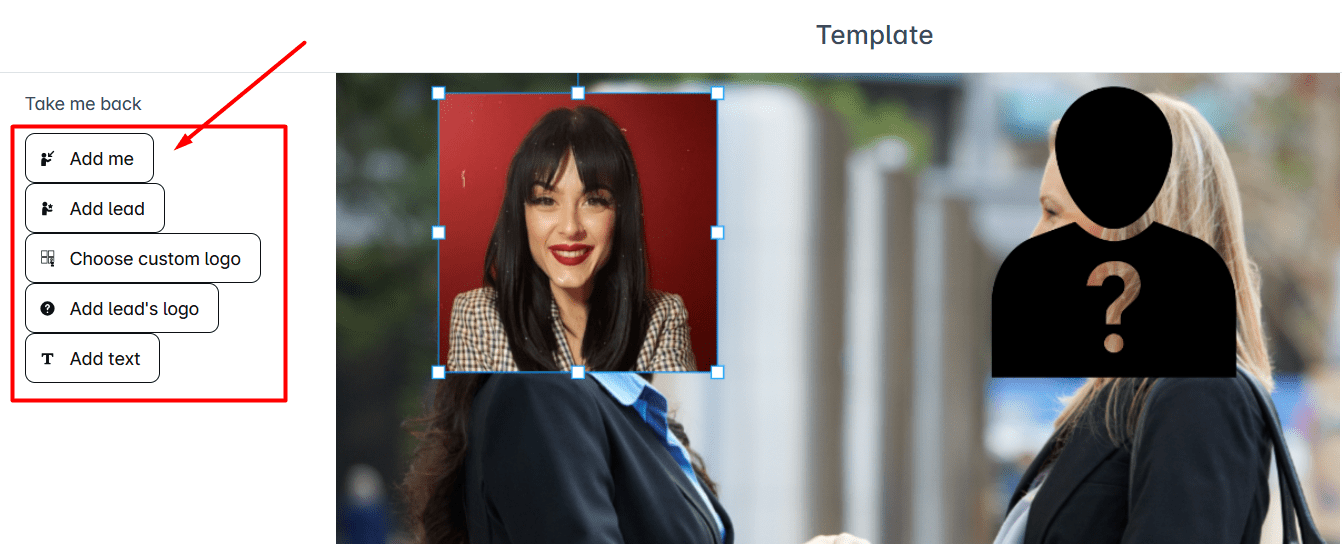
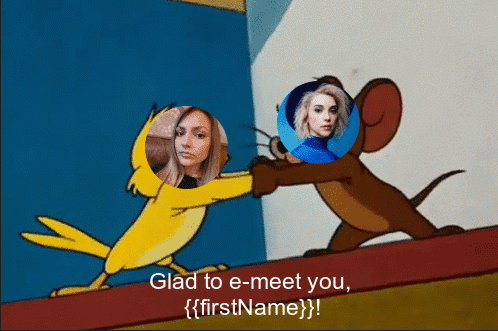
Finally, insert the unique visual into your message, kick off your campaign, and watch your response rate increase to 63% & more!
Don’t trust this is possible?
Just look at the impressive results we had with this image!

2. Provide a strong value proposition
Your targeted outreach messages need to convey the value you bring to the table. That said, it’s not enough for your prospects to understand what you’re offering. They need to understand why it matters to them specifically.
A strong value proposition addresses their pain points and demonstrates how your solution can solve them.
Now, say you were selling project management software. Don’t bore your prospects to death by talking about the features on and on! Instead, position your tool as one that increases efficiency, saves time, and reduces operational costs.
Here’s an example message to paint a better picture:
"Hi Lisa,
I know how challenging it can be to keep multiple projects on track, especially with the fast-paced environment at AdVantage Pro. That’s where TaskFlow can make a difference. Our software centralizes tasks and automates routine processes so you can focus on what really matters.
With TaskFlow, you’re looking at saving around 10 hours a week and cutting operational costs by up to 20%—giving you more time to drive the strategic growth you’re aiming for."
If you can, also incorporate testimonials or case studies in your pitch to back up your claims and build credibility in your prospects’ eyes.
So, ensure your value proposition is front and center in your messages, and you’ll capture attention immediately.
3. Nurture relationships beyond initial contact
Targeted outreach is not a one-and-done process. The connections you establish need to be nurtured for the cold prospects to remain warm leads.
So, after your initial contact, send follow-ups to keep the dialogue alive.
Remember to check in regularly and keep providing value long-term.
You can do so by, for example, sharing a useful ebook, inviting them to a webinar, or giving them early access to new features. This shows you’re always working to support their business, making them more likely to turn to you when they need your services.
Take a look at this example:
"Hi Alex,
I wanted to follow up and share something I think you’ll find valuable. Next week, we’re hosting a webinar on advanced project management strategies specifically designed for teams like yours at Bright Ideas Co.
It’s a great opportunity to dive deeper into techniques that can help streamline your processes and drive better results. I’d love for you to join us—let me know if you’re interested, and I’ll send over the details.’’
Challenges of targeted outreach and how to solve them
While targeted outreach can bring excellent results, chances are not everything will go according to the plan. That's why you must prepare for challenges and learn how to overcome them once they come.
Rejections
You'll encounter 3 types of leads during targeted outreach:
- Unresponsive leads
- Those who react positively to what you are offering them
- Those who react negatively or throw objections your way
Objections are a natural part of the process, but receiving them doesn't automatically mean a lead has gone to waste.
Sales representatives, for example, encounter them on a daily basis. However, top sales reps are top for a reason because, as our CEO, Relja, puts it:
‘’They see each objection as a different opportunity.‘’
So, instead of dreading the objections, learn how to handle them gracefully to turn them into precisely that!
Objection handling involves active listening to understand where the lead is coming from without interrupting or becoming defensive.
It also implies acknowledging their concerns to defuse tensions and allow for a constructive conversation.
When faced with a specific objection, you also want to address it with relevant information that highlights the benefits of your product or service. Use data, case studies, or testimonials to back up your claims.
Also, if the objection concerns pricing, emphasize the long-term value and ROI your product/service offers. On the other hand, if it concerns features, explain how your solution better meets their needs than competitors.
Furthermore, keep in mind that sometimes an objection might signal that the lead needs something slightly different. So, be flexible and offer alternatives or adjustments that might better suit them.
If they remain hesitant, don't push too hard. Instead, suggest a future check-in and express your willingness to help whenever they are ready.
Poor time management
Targeted outreach is more complex than traditional outreach. As such, it takes more time. Therefore, it's not surprising that some people who use it struggle with poor time management.
Inefficient time use can lead to missed opportunities and subpar results.
Nonetheless, you can get ahead of it if you prioritize tasks based on their impact on your outreach success. Focus on high-value activities such as identifying high-potential leads, personalizing messages, and analyzing campaign performance.
Not making data-driven decisions
Speaking of analyzing campaign performance, did you know that many people tend to overlook it?
When you don’t keep up with campaign results, you miss out on making data-driven decisions that can improve its performance.
Fortunately, Skylead streamlines campaign tracking thanks to a dedicated Reports page.
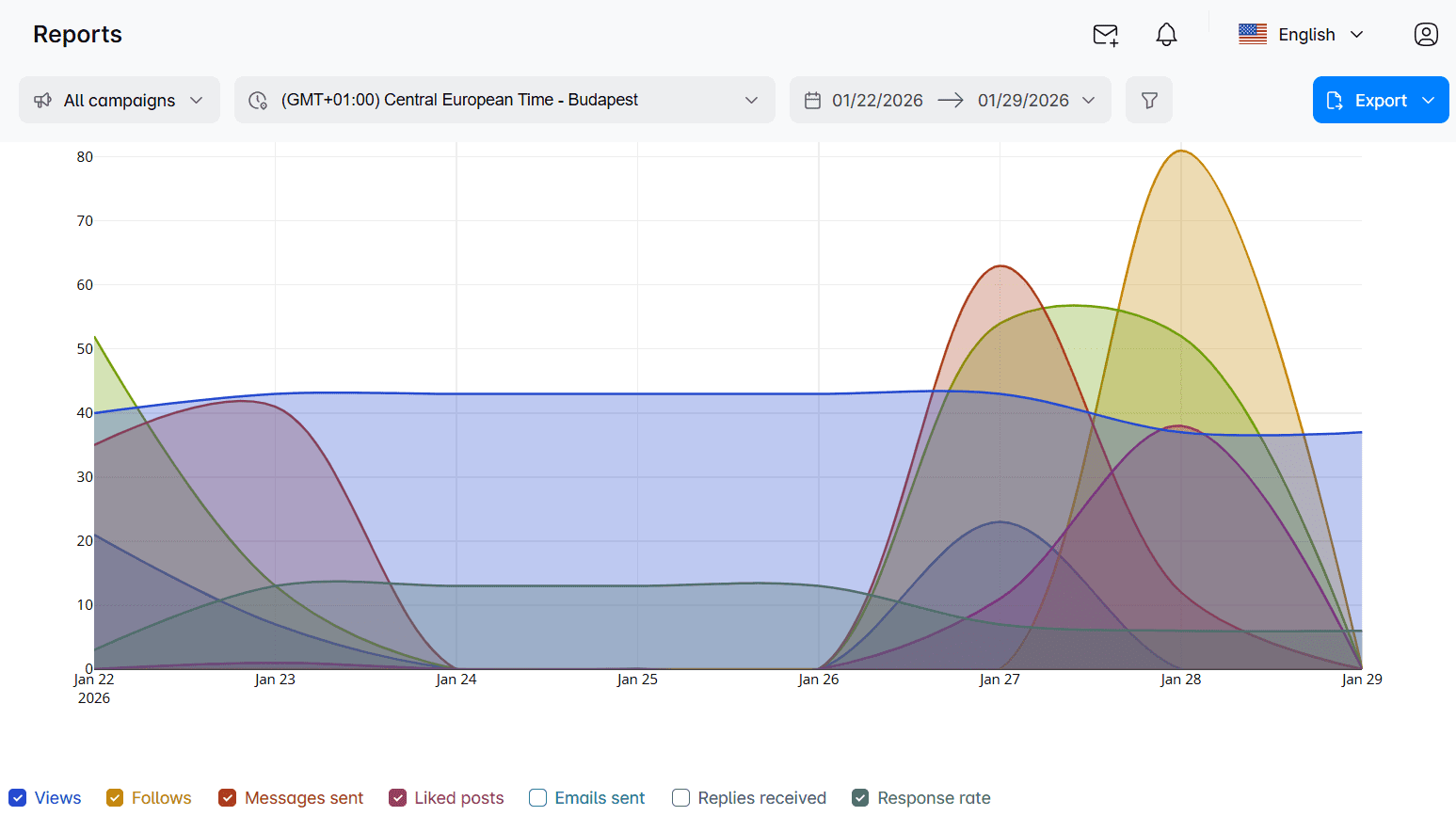
Here, you can analyze your campaigns for any given time period in 3 different view modes:
- Graph - To observe oscillations and spot trends easily;
- Table - To keep track of metrics and review daily changes;
- Step-by-step - To identify the most promising sequences and review the results of your A/B tests.
Now, say your campaign involved multiple channels. Think how much time you'd be losing switching between them manually, only to keep the conversations going.
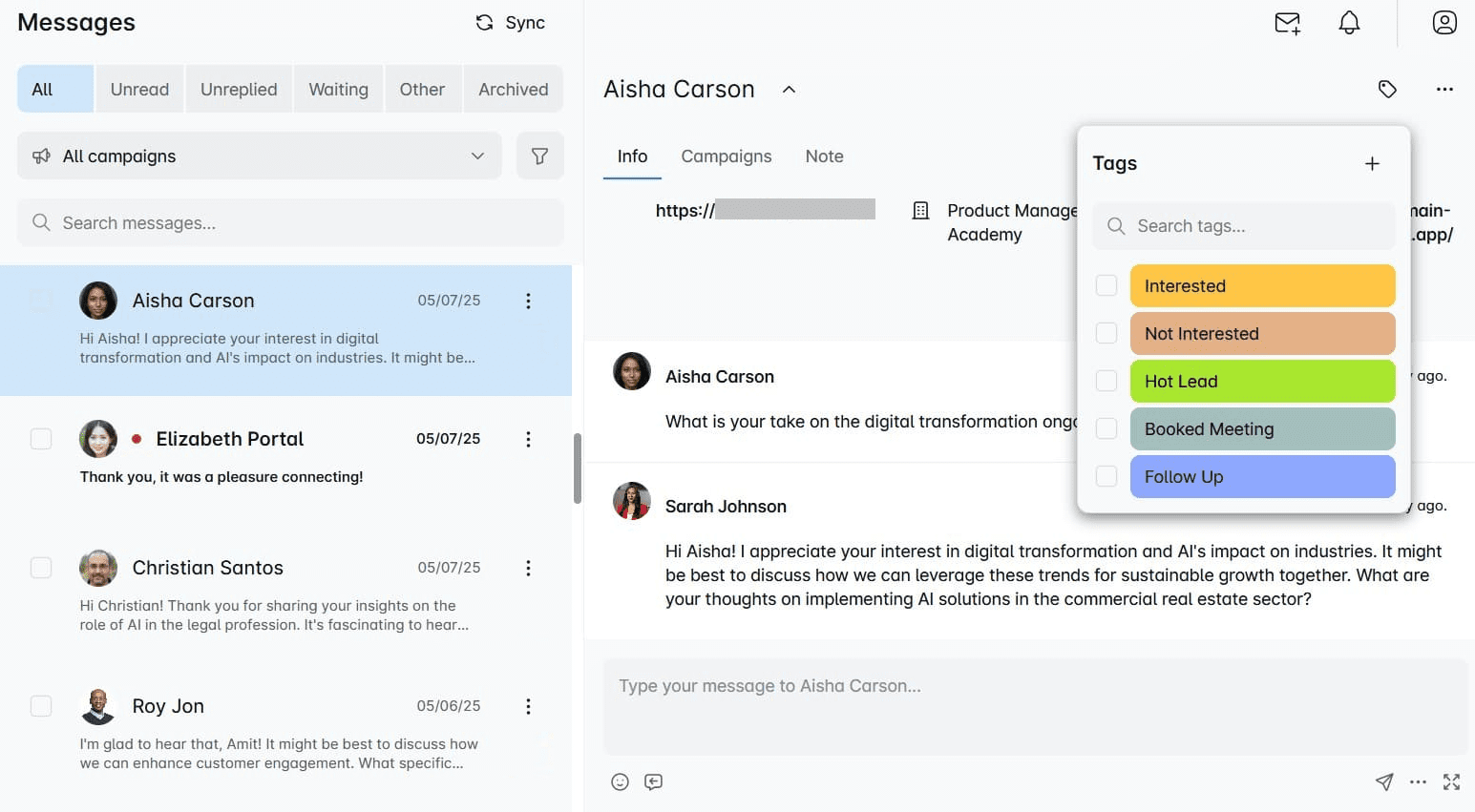
Luckily, Skylead also comes with a Smart inbox that holds all your email and LinkedIn correspondence in one place. And since it does, it makes it possible to streamline your workflow without missing important interactions. What's more, you can even label chats for added organization and improved ROI and conversion tracking.
Targeted outreach message templates for sales & marketing
1. Targeted outreach message templates for sales
#1 Connection request
Results we got:
- Acceptance rate: 34%
- Response rate: 17%
Hi {{FirstName}},
I noticed your work in {{Industry}} and thought we could connect.
I'm researching how companies like {{LeadsCompanyName}} can achieve {{UniqueValueProposition}}.
Let's connect on this!
Example:
Hi Emily,
I noticed your work in the tech industry and thought we could connect.
I'm researching how companies like InnovateX can achieve scalable growth through data-driven marketing strategies.
Let's connect on this!
#2 Email
Response rate: 13%
Subject: {{YourProduct}} - Outperforming top {{IndustryRole}}...
Hi {{firstName}},
Can your current {{Solution}} {{UniqueValueProposition}}?
Clients like {{ClientExample}} are {{SpecificResultsAchieved}} with less than {{TimeSpent}} of work every {{TimePeriod}}.
Would love to share some examples if you're open to it.
Best regards,
{Signature}
Example:
Subject: Skylead - Outperforming top sales rep...
Hi Alex,
Can your current platform fully automate your process of LinkedIn outreach + find valid business + send emails + image personalization at scale (see screenshot example)?
Clients like TechMasters are reaching over 3,000 unique prospects across LinkedIn + email with less than 3 hours of work every single month.
Would love to share some examples if you're open to it.
Best regards,
Sarah Mitchell
2. Targeted outreach connection message and email when referencing someone’s post
#1 Connection request
Results we got:
- Acceptance rate: 76%
- Response rate: 35%
Hi {{FirstName}},
I saw your post about {{PainPoint}} and how it’s impacting your team at {{LeadsCompanyName}}.
I’ve been working on a solution that addresses this challenge by {{UniqueValueProposition}}.
Let’s connect and explore this!
Example:
Hi Jessica,
I saw your post about the difficulties with customer segmentation and how it’s impacting your team at TechWave Solutions.
I’ve been working on a solution that addresses this challenge by using AI-driven analytics to create more precise segments.
Let’s connect and explore this!
#2 Email
Response rate: 3%
Subject: Give your {{Field/Activity/Sector}}a boost with {{Product/ServiceName}}!
Hi {{FirstName}},
I recently saw your post about {{PainPoint}} and was impressed by your insights at {{LeadsCompanyName}}.
Given your focus on {{SpecificArea}}, I thought you might be interested in a new approach that has helped companies like {{ClientName}} achieve {{SpecificBenefit}}.
Our product/service, {{Product/ServiceName}}, is designed to {{BriefDescriptionOfBenefits}}, and I believe it could directly address {{PainPoint}}.
I'd love to schedule a brief call to show you how {{Product/ServiceName}} can help {{LeadsCompanyName}} achieve greater results.
Would you be available for a chat next week?
Looking forward to hearing from you.
Best regards,
{{Signature}}
Example:
Subject: Give your marketing a boost with EngagePro!
Hi Sarah,
I recently saw your post about the challenges of increasing customer retention and was impressed by your insights at BrightIdeas Co.
Given your focus on customer engagement, I thought you might be interested in a new approach that has helped companies like InnovateX achieve a 30% boost in retention rates.
Our product, EngagePro, is designed to deliver personalized content at scale, driving deeper connections with your audience, and I believe it could help solve the challenges of increasing customer retention you’re facing.
I'd love to schedule a brief call to show you how EngagePro can help BrightIdeas Co. achieve greater results.
Would you be available for a chat next week?
Looking forward to hearing from you.
Best regards,
Lisa Reynolds
Frequently asked questions (FAQs)
1. What specific data sources or tools can be used to identify the target audience?
Leverage platforms like LinkedIn and Sales Navigator, pull data from gated content submissions or your CRM to identify and pinpoint your target audience. The former have filters that allow for precise targeting, whereas the latter offers insights into information like audience demographics, behavior, and preferences.
2. How do you measure the success of a targeted outreach campaign?
To measure the success of your campaigns, you can track metrics like acceptance rates, open rates, response rates, conversion rates, lifetime value, and return on investment (ROI).
3. How do you balance personalization with scalability in targeted outreach campaigns?
To balance personalization with scalability, use automation tools that incorporate variables such as names, job titles, and company details into your messages. Also, opt for tools with dynamic images and GIF personalization that tailor visuals to each recipient. This enhances personalization, making outreach more engaging without increasing manual effort.
Making targeted outreach work for you
Targeted outreach can be a game changer for your business. After all, by focusing your efforts on the right audience, you maximize your chances of success while conserving valuable resources.
Armed with the actionable strategies and templates we provided, you’re now ready for the next phase: implementation!
So, outreach away with all facts in check and watch as your conversion rates soar, your brand recognition grows, and your ROI hits new heights.
But not before you’ve signed up for your 7-day free trial with Skylead—because impactful outreach starts with the right tool!