LinkedIn Sales Navigator filters: find and qualify the right leads

Updated on: October 1st, 2026
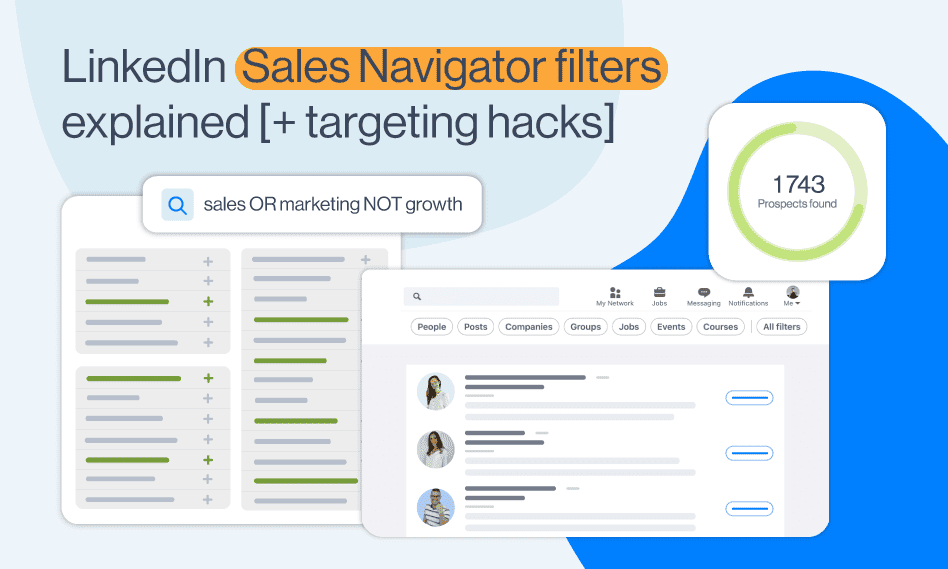
LinkedIn Sales Navigator filters help you narrow your search to the people and companies that fit your business. Lead filters find people. Account filters find companies. The trick is choosing the right combination, then checking that the results actually match who you want to reach.
Sounds simple, right? It gets a little less simple when you’re choosing between geography and company headquarters, job titles and seniority, or a saved search and a lead list.
In this guide, we’ll explain the filters, walk through two search examples, and show you how to turn a promising result into a shortlist you can use. We’ll also cover where Skylead can help with the next step: finding relevant contacts within your target accounts and organizing outreach.
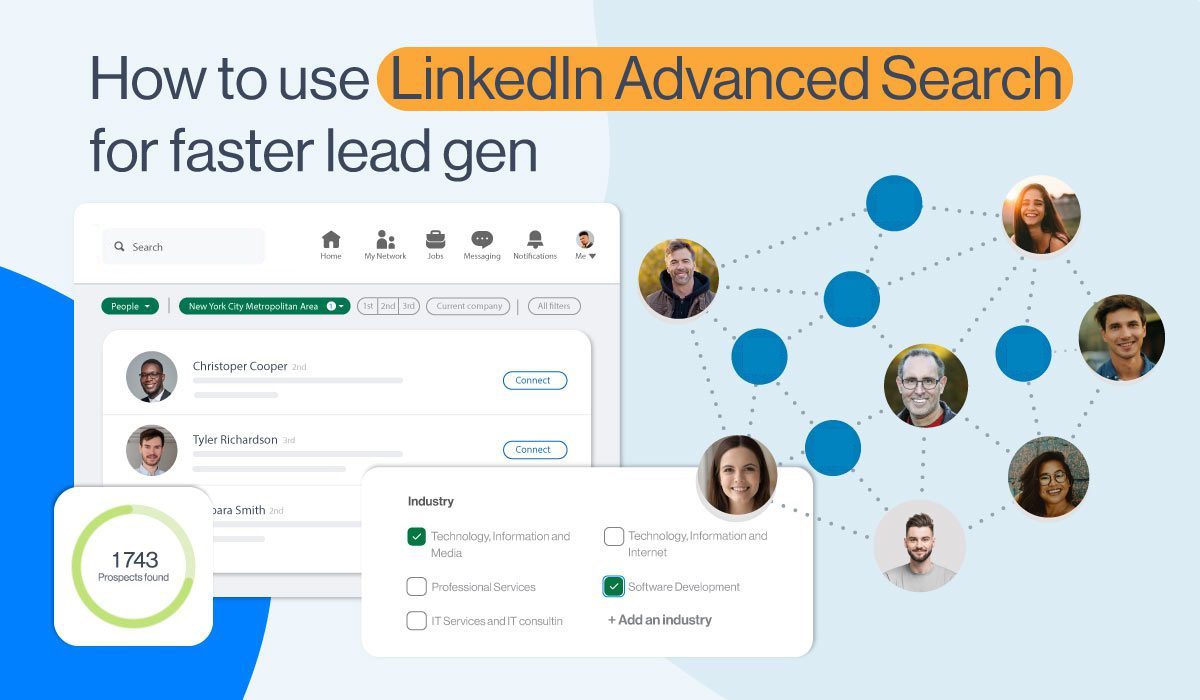
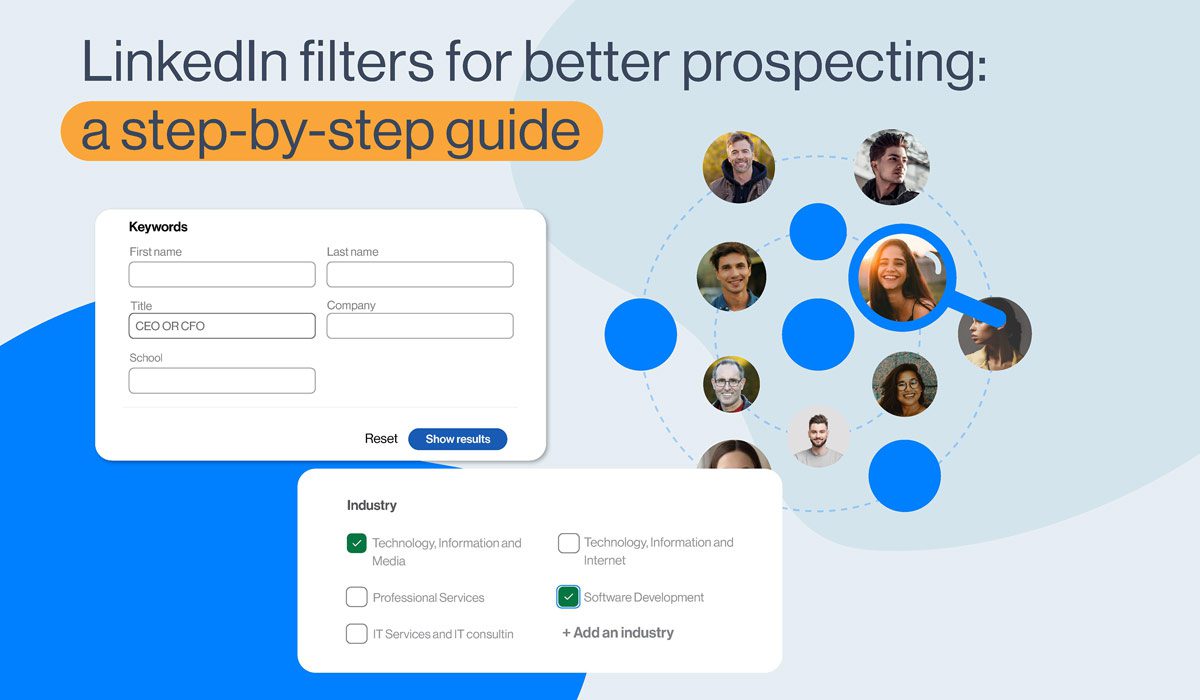
Filters are the foundation of Sales Navigator advanced search: combine company and person criteria instead of relying on one broad keyword. That makes LinkedIn prospecting easier to organize around a specific market.
Skylead is not affiliated with, endorsed by, or connected with LinkedIn.
Should you start with lead filters or account filters?
Start with what you already know about your ideal customer.
| Your starting point | Use | What to do next |
|---|---|---|
| “I need sales directors at mid-sized software companies.” | Lead search | Combine role, company size, and location; review each person’s current role. |
| “I need companies in a specific market before I decide whom to contact.” | Account search | Find suitable companies, save an account list, then search for relevant people within those accounts. |
| “I already have a list of target companies.” | An account-list workflow | Find the accounts in Sales Navigator, then apply lead filters to the list. |
For an account-first approach, define your ideal customer profile before adding filters. For a person-first approach, decide which roles need your solution and who is likely to influence the purchase.
Don’t mix up location filters: Geography describes where a person is based. Headquarters location describes where the company is headquartered. A person in Germany can work for a company headquartered in the United States. Choose the criterion that matches your territory.
To get started, open Sales Navigator and choose Lead filters or Account filters. Add criteria and review the results as you go. In our Sales Navigator masterclass we explain the current flow.
LinkedIn Sales Navigator lead filters explained

Lead filters search personal profiles. Use them to answer three questions: Does this person fit the role? Does their company fit your market? Is there a relevant reason or route to start a conversation?
The reference below covers the main lead-filter groups. Labels and availability can vary with your subscription and updates. For the current reference, see LinkedIn’s lead and account filter definitions.
Company and role: find the right people at the right companies
| Filter | Use it for | What to check |
|---|---|---|
| Current company | People working at selected companies. | Open their current experience and check the relevant employer. |
| Past company | People with experience at a selected employer. | Past employment is context; it doesn’t tell you where they work now. |
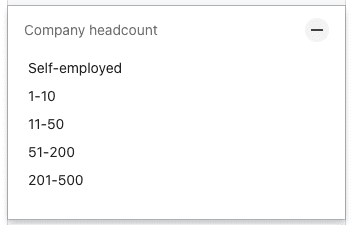
| Company headcount | People at companies within your target size range. | Check the company when size is a strict qualification requirement. |
| Company type | Public, private, nonprofit, and other company categories. | A private company isn’t necessarily a startup. |
| Company headquarters location | People whose current employer has headquarters in your territory. | Use Geography if the person’s own location matters. |
| Function | A broad professional function, such as sales or marketing. | Combine it with title or seniority when the role needs to be more specific. |
| Current job title | The roles you want to contact today. | Include relevant title variations and inspect ambiguous matches. |
| Past job title | Previous role experience. | Don’t use it as a substitute for a current decision-making role. |
| Seniority level | A person’s level in the organization. | Seniority is different from a job title and doesn’t establish buying authority. |
| Years in current company | Tenure with the current employer. | Use it only when company tenure matters to your offer. |
| Years in current position | Tenure in the current role. | A new role and a new employer aren’t the same thing. |
Function, title, and seniority work best when they have different jobs. Function identifies the professional area. Title narrows the role. Seniority helps separate individual contributors from management. Adding all three without a reason can also filter out useful prospects.
Personal filters: narrow your territory and background criteria
| Filter | Use it for |
|---|---|
| Geography | The person’s region, country, city, or postal-code area. |
| Industry | People associated with your target industry categories. |
| First name / Last name | Locating a known person. |
| Profile language | The language selected for the person’s profile, not proof of language proficiency. |
| Years of experience | Overall professional experience rather than tenure in one role. |
| Groups | Members of selected LinkedIn groups. |
| School | Educational background that’s relevant to your search. |
For regional searches, it helps to know the abbreviations: DACH means Germany, Austria, and Switzerland; Benelux means Belgium, the Netherlands, and Luxembourg; EMEA means Europe, the Middle East, and Africa. If you sell into only part of a region, select the specific countries instead of assuming the whole region is suitable.
Looking for a Sales Navigator industries list? Use the Industry selector to find the categories relevant to your offer, then check the actual businesses in the results. Industry categories are a starting point, not a substitute for checking whether a company sells the type of product you need.
Buyer intent and recent updates: find context for your next conversation
These filters can help you prioritize a relevant shortlist. They shouldn’t replace the company and role criteria that make someone a fit.
- Account has buyer intent: finds people at accounts showing interest in your company. An account-level signal doesn’t establish that every employee is researching your product.
- Category interest: relates to potential interest in a product category, which is different from interest in your company.
- Following your company: identifies followers of your LinkedIn company page.
- Viewed your profile recently: helps find people who have recently viewed your profile.
- Viewed your Company Page recently: covers page visits within 90 days, subject to visibility settings. LinkedIn’s feature announcement specifies Advanced/Advanced Plus subscriptions purchased through an account representative.
- Changed jobs: highlights changes within 90 days.
- Posted on LinkedIn: finds people who posted within 30 days.
LinkedIn’s Buyer Intent FAQ explains the distinction between company and category interest.
A recent post gives you something specific to research. A new job gives you a reason to review the person’s responsibilities. Neither tells you they have budget, want a new tool, or are ready to buy. Keep the message relevant to a problem you can help with.
Best path in: find a relevant connection
- Connection: narrow by your relationship to a lead, including 1st or 2nd degree connections and other available network options.
- Connections of: explore a particular person’s network where supported.
- TeamLink connections of: look for colleagues who can help with an introduction, where available.
- Past colleague: look for a professional connection through company history.
- Past customer: find people with a connection to a customer company; this feature requires Advanced Plus.
- Shared experiences: look for common schools, groups, or company history—not simply people who have posted recently.
TeamLink is available on Advanced and Advanced Plus. Check the specific TeamLink options included in your account. Be aware that the mutual connection is a possible introduction route, not permission to imply a relationship you don’t have.
Groups can also help you find industry peers. If that’s useful for your market, see our guide to targeting members of a LinkedIn group. Review the group and the person’s role before assuming membership makes them a qualified prospect.
Workflow filters: organize people you already know about
Persona reuses a defined role profile. Account lists helps you find people within selected companies, while Lead lists narrows a group of people you’ve saved. Saved leads and accounts gives you another way to work with saved prospects.
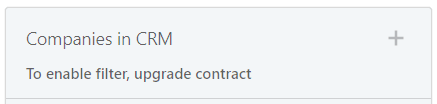
People you interacted with helps you include or exclude previous interactions. People in CRM works with connected CRM records. Native CRM integration requires Advanced Plus and an appropriate setup; a filter by itself doesn’t create a CRM integration. Check LinkedIn’s CRM setup guidance before planning that workflow.
LinkedIn Sales Navigator account filters explained
Account filters search company pages. They’re useful when the company’s market, size, or structure matters more than finding a particular title first.
Company attributes
| Filter | Use it for | Decision tip |
|---|---|---|
| Annual revenue | Reported annual revenue, not revenue growth. | Use it when revenue is a meaningful qualification criterion. |
| Company headcount | Company size. | Start here when your offer fits a particular size of business. |
| Company headcount growth | Employee growth over 12 months. | Investigate why the business is growing before using that context. |
| Department headcount | The size of a specific department. | Useful when your product supports one team rather than the whole company. |
| Department headcount growth | Department-level employee growth over 12 months. | Check whether growth creates a problem your offer addresses. |
| Headquarters location | The company’s headquarters territory. | It doesn’t establish the location of every employee. |
| Industry | Company industry categories. | Check subindustries and the company’s actual offering. |
| Number of followers | Company-page audience size. | Follower count doesn’t establish revenue or buying power. |
| Fortune | Fortune-ranked companies. | Use it only when those accounts match your target market. |
You don’t need every attribute. If company size and department size already describe your market well, adding a revenue requirement may exclude a relevant company with incomplete information.
Spotlights, buyer intent, and workflow
Job opportunities highlights hiring activity. Recent activities provides company-change context. Connection can help identify a route into an account. Buyer intent helps prioritize companies showing interest in your business.
Use hiring or company changes as a reason to investigate, not as proof of expansion, available budget, or an immediate purchase. Read the specific event before mentioning it in outreach.
Companies in CRM, Saved accounts, and Account lists help you work within existing groups of accounts rather than search the entire market again.
Two Sales Navigator searches you can build
The examples below are hypothetical starting points, not results from a test or a promise of a particular number of leads. Replace the territory and criteria with your own ICP.
Example 1: find sales leaders at software companies
Let’s say you offer sales coaching to software companies with 51–200 employees and want to reach sales leaders based in the United Kingdom.
- Open Lead search.
- Set Geography to the United Kingdom.
- Choose the relevant software industry category or categories.
- Set Company headcount to 51–200.
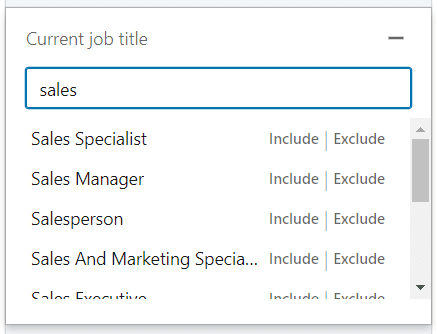
- Use Current job title for roles such as Head of Sales, Sales Director, and VP of Sales.
- Review the results before adding a seniority requirement. Add it if it removes unsuitable roles without excluding titles you need.
- Exclude competitors or existing customers where the relevant exclusion is available.
Here’s an illustrative Boolean title string:
("Head of Sales" OR "Sales Director" OR "VP of Sales")Check profiles for current responsibility, the relevant company, and fit with your service. Add Posted on LinkedIn only if recent posts are useful to your outreach approach; keeping it off leaves room for suitable people who don’t post.
Example 2: find accounts first, then the right contacts
Suppose you offer a service to manufacturing companies headquartered in Germany, Austria, or Switzerland, with 201–1,000 employees.
- Open Account search.
- Set Headquarters location to those countries.
- Choose Manufacturing and review the included subindustries.
- Include the 201–500 and 501–1,000 headcount ranges.
- Check company pages and websites for what each business actually manufactures.
- Save suitable companies to an account list.
- Switch to Lead search, select that account list, and apply the roles relevant to your service.
If employee location matters too, add Geography in the lead search. Don’t assume everyone at a DACH-headquartered company works in DACH.
This account-first approach separates two decisions: Which companies fit? and Who should we contact there? That’s also the foundation of account-based prospecting.
Sales Navigator search tips: check the list before outreach
Use Boolean search for a specific purpose
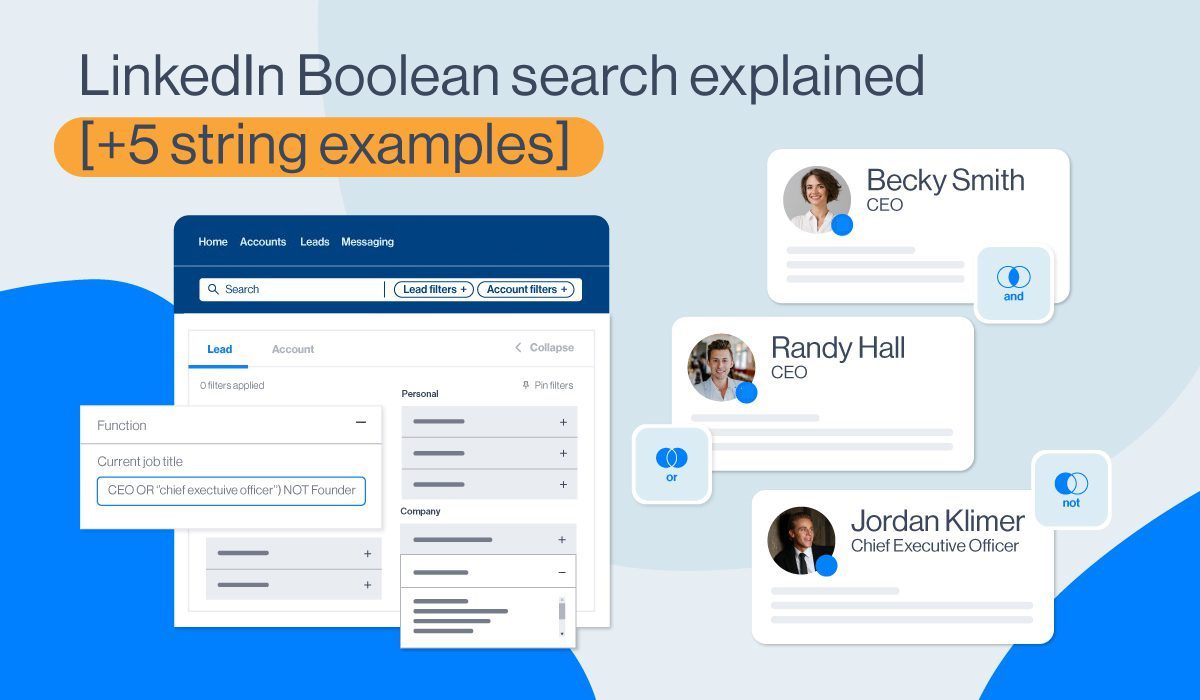
Boolean operators help describe title variations or narrow keywords. Use uppercase AND, OR, and NOT, straight quotation marks for phrases, and parentheses to group alternatives.

For example, a broader keyword search could use:
("revenue operations" OR "sales operations") NOT recruiterChoose the field carefully. A keyword match isn’t proof that a person currently holds the role you want. Use Current job title for role targeting, then inspect the profile. Keep strings short enough to understand and debug.
Boolean support in company, title, and keyword fields, with an operator limit of about 15; wildcard searches aren’t supported. See LinkedIn’s Boolean instructions and our Boolean search guide with string examples.
Exclude people and companies you don’t want to contact
Start with existing customers, competitors, unsuitable businesses, and people who shouldn’t receive another approach. Use the Exclude option where supported, and review the selected exclusions before saving.
You can also keep lead or account lists for exclusions rather than rebuilding the same rules every time. Connected CRM exclusions can help identify records already in your CRM.
Excluding something from one search isn’t the same as maintaining a campaign-wide suppression list. Carry your exclusions and contact preferences into whichever outreach process you use.
Review a sample instead of trusting the result count
Open a small sample of results before committing the whole shortlist. Check:
- Does the person currently hold the role you need?
- Is the relevant employer the company you intended to target?
- Does the company’s offering match your niche, beyond its industry label?
- Is the location correct for the person, the headquarters, or both?
- Have you excluded existing relationships and people you shouldn’t contact?
If the same mismatch appears repeatedly, change the relevant criterion and review another sample. A smaller usable list is more helpful than a larger list with no clear reason to contact its members.
Know what to do with zero or noisy results
Too few results? Remove optional activity or tenure criteria first. Broaden title variations, and check whether a revenue or department-size requirement is essential.
Too many irrelevant results? Add a role-specific field, tighten your account criteria, or use a verified account list. Don’t keep adding filters unless you can explain what each one removes.
One current detail is easy to miss: We experienced that a lead search with no results may adjust a filter to show the closest matches. Check for an adjustment notice and review the criteria before treating those results as exact matches. See its search guidance.
Saved searches, lists, CSV uploads, and plan requirements
A saved search keeps the criteria; a list keeps selected prospects
A saved search lets you rerun a set of criteria and receive notifications about new matches. A lead or account list organizes the people or companies you’ve chosen to save. A new search match still needs reviewing before it belongs in your outreach list.
To save a desktop search:
- Choose lead or account search and refine the criteria.
- Turn on Save search to get notified of new results near the top of the filter pane.
- Give the search a name that describes the territory and target.
- Review new matches, then save suitable people or companies to a list.
Saved searches have a weekly emails and homepage alerts. Build a review routine that fits your team; don’t confuse an alert with an automatically qualified prospect.
Upload a company CSV when you already know your accounts
Native CSV upload is for account lists, not lead lists, and requires Sales Navigator Advanced or Advanced Plus.
Go to Accounts, choose the relevant list, and use Upload accounts. Download the current template, prepare your file, map its columns, and complete the upload. Then check the match report for unmatched or incorrectly matched companies before finding contacts.
Follow LinkedIn’s current CSV upload instructions for requirements. Uploading a company list and exporting a lead list are different tasks.
Check the feature you need before choosing a plan
| Workflow | Availability to check |
|---|---|
| Upload account lists by CSV | Advanced or Advanced Plus. |
| Buyer Intent and Product Category Intent | Advanced or Advanced Plus; confirm setup and specific options. |
| Viewed your Company Page recently | Advanced/Advanced Plus, with the purchase-route condition noted in LinkedIn’s announcement. |
| TeamLink | Advanced or Advanced Plus; individual options may differ. |
| Past customer | Advanced Plus. |
| Native CRM integration | Advanced Plus, compatible CRM, and configured integration. |
Choose a plan around a workflow you’ll actually use. If you mainly need individual research and filtering, don’t assume a team or CRM feature is necessary. If you need native CRM workflows, check compatibility and setup before upgrading.
What about AI-assisted search and suggested filters?
Sales Navigator can suggest filter combinations from search terms - keyword-to-filter mapping and suggested filters. That’s useful, but it doesn’t mean every suggested criterion matches your ICP.
If your account offers a conversational or AI-assisted search option, describe the role, company type, size, and territory you need. For example:
Find sales leaders based in the United Kingdom at software companies with 51–200 employees.
Then inspect the actual criteria and a sample of results. Did the search interpret the person’s location correctly? Did it choose the right industry and current role? Correct those details before saving.
Search suggestions are different from research features such as Account IQ or Lead IQ. Availability can depend on your account and settings. Also, from our experience, check outputs for accuracy. You can still build the core searches in this guide with the available manual filters.
Where Skylead fits: from target accounts to outreach
Sales Navigator helps you research and narrow your market. If you’re happy reviewing prospects and managing outreach manually, that may be enough for your workflow.
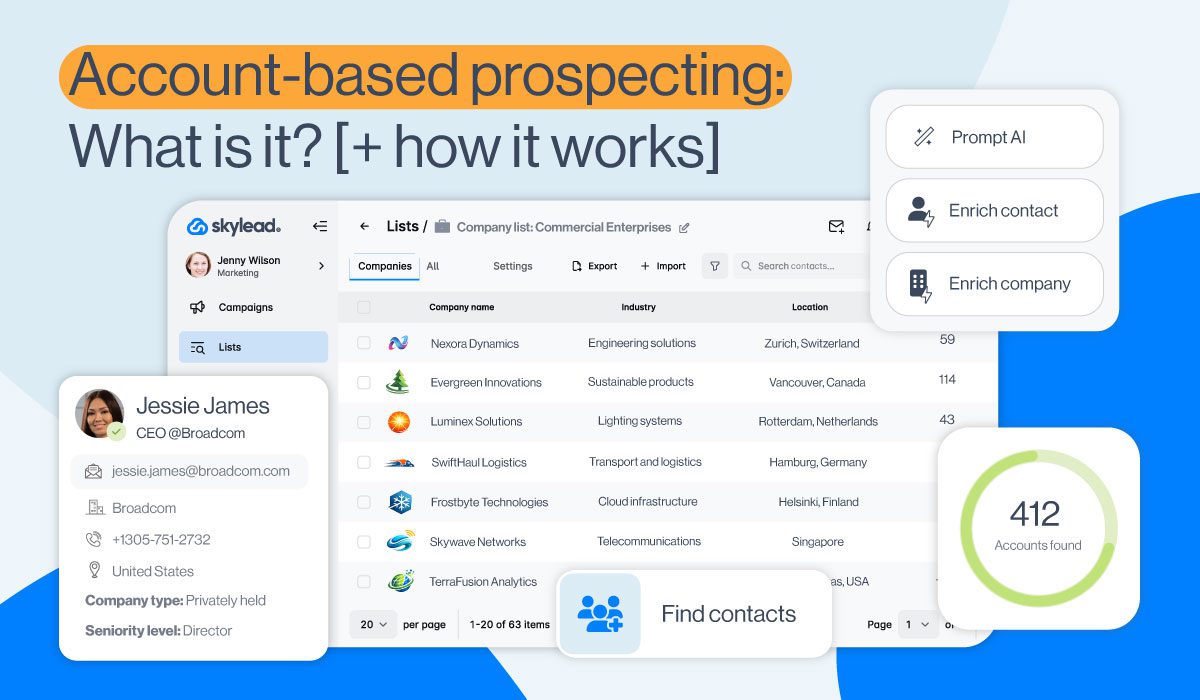
If you want help working from a defined company list, take a look at Skylead’s account-based prospecting workflow. It lets you:
- find and create company lists,
- set criteria for matching contacts within those companies,
- enrich those contacts with AI data enrichment,
- start multichannel outreach sequences,
- and use AI SDR to handle conversations for you.
Here’s the practical handoff: decide which accounts fit, define the roles you need, review the contacts, and write messages around a relevant problem. Skylead’s LinkedIn automation and email outreach capabilities can help organize the outreach step; they don’t replace checking fit or writing a useful message.
Want to see whether the workflow fits your team? Try Skylead free for 7 days and evaluate it with a focused set of target accounts. See the current plans and trial offer for details.
Your next step
Start with the person or company criteria that genuinely define a fit. Add one useful signal at a time, check the results, and save the search once it’s doing the job you need.
Before outreach, make sure your shortlist answers three questions: Why this company? Why this person? Why this message? If you can answer those, your filters are helping you make a decision—not just build a bigger list.