Account-based prospecting: What is it & how it works? [2026 guide]

Account-based prospecting is the secret sauce to winning more high-value deals in 2026.
Don’t trust us? Let’s go over a familiar scenario to paint a better picture.
A prospect tells you they’re not interested, and what happens next? In most cases, the entire company gets marked as a dead end and everyone moves on to the next person on the prospecting list.
But the thing is, one prospect is NOT the entire company. Chances are, they weren’t even a business decision-maker but you never got to find that out because:
- A: You didn’t research the company hard enough, and
- B: One ‘’no’’ made you drop the entire account.
But why would you even start with a random list of prospects and hope some of them work at companies worth targeting when there’s a better way? When there’s account-based prospecting.
The premise is simple: you start with the companies that match your ICP, research them, find the right decision-makers inside them, and only then move on to outreach.
Of course, there’s a lot more to account-based prospecting than meets the eye, so today, we’ll be going over:
- What account-based prospecting is
- How it differs from traditional prospecting and related account-based terms
- Why it matters
- How to do it step by step
- And the tool to help execute it all. Spoiler alert, it’s Skylead. 🙂
Let’s dive in!
What is account-based prospecting and how is it different from traditional prospecting?
Account-based prospecting (ABP) is the process of finding and researching high-value companies that match your ideal customer profile, identifying the right decision-makers inside them, and preparing the account for sales outreach.
You may be thinking: isn’t that what prospecting as a whole is all about?
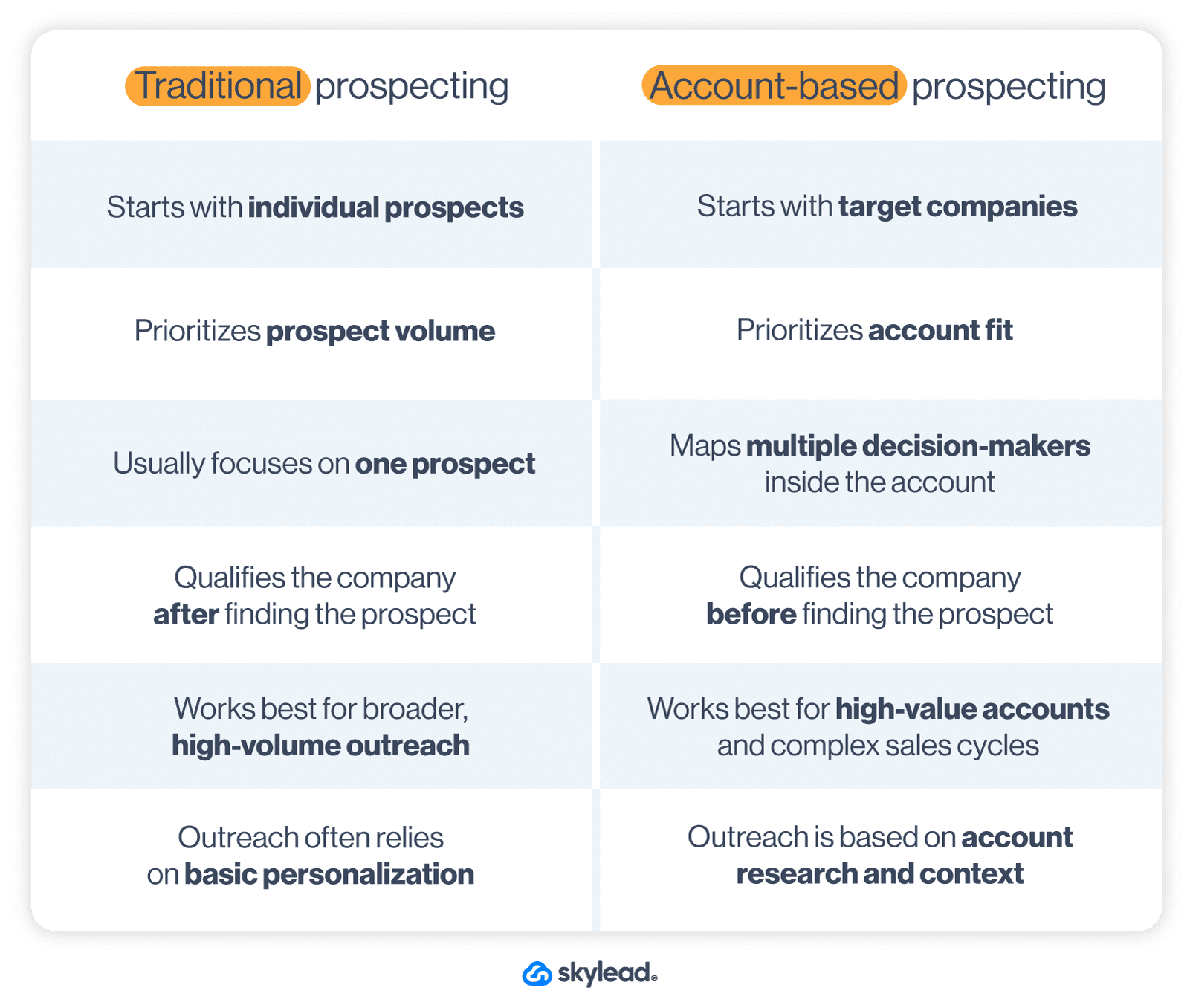
Well, not exactly. Traditional prospecting is prospect-first, meaning you begin your search for people based on specific criteria, such as a job title, seniority, location, industry, or company size. Then, you reach out to them and qualify the company along the way.
In the meantime, account-based prospecting is company-first. You identify the accounts that match your ICP, research their needs, check for buying signals, map the buying committee, and only then look for the right contacts inside those accounts.
Neither approach is automatically better. In fact, traditional prospecting is the essence of B2C sales.
However, if you’re in B2B and going after higher-value accounts, selling to multiple decision-makers, or trying to build a cleaner pipeline, ABP just makes more sense.
Why? Because it helps you answer the most important question right away, and that is ‘’Is this company actually worth our time?’’
What are the advantages of account-based prospecting?
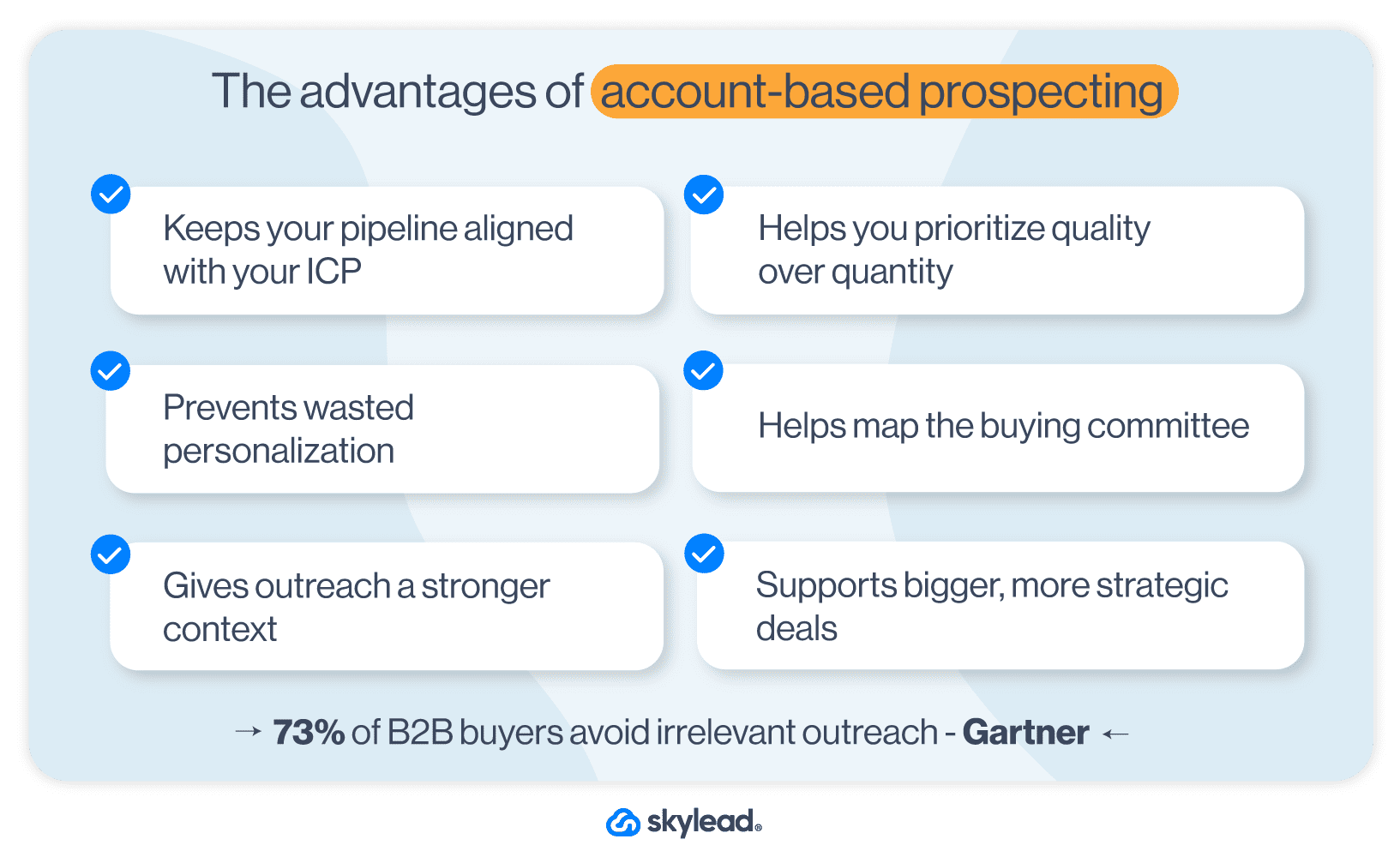
The biggest advantage of account-based prospecting is focus. Instead of filling your pipeline with as many prospects as possible and hoping some of them convert, you narrow your search to companies that are actually worth your time, meaning they are more likely to convert, have a higher lifetime value, and become brand ambassadors.
That alone can change the quality of your entire sales process.
But other than focus, there are a few more benefits that go in favor of ABP.
1. It keeps your pipeline aligned with your ICP
You can have 2,000 prospects with the right job title and still end up with a list full of companies that aren’t a good fit for your business.
Account-based prospecting helps you avoid that by putting the company first.
Rather than prospecting with the mindset of looking up individuals with a specific job title, you prospect with the mindset of looking up companies that are in the market for what you sell. Only after that do you look for the people inside them.
This keeps your pipeline cleaner because every prospect you add is tied to an account that has already passed the qualification process.
2. It helps you prioritize quality over quantity
Traditional prospecting often pushes reps toward volume. And don’t get me wrong, volume has its place. But if you’re selling to high-value B2B accounts, more isn’t always better.
With ABP, you’re concentrating all your effort on where it has the highest chance of paying off, a.k.a. on fewer but better-fit accounts.
That leads to more thoughtful research, better context, and stronger sales conversations once cold outreach begins.
3. It helps you avoid wasting personalization on the wrong companies
Let’s face it, personalization takes time. Sure, you can write a custom icebreaker for every prospect on your list. You can mention their latest LinkedIn post, their company news, or something from their website. But if the company was never a good fit to begin with, what exactly did you win?
Not all companies deserve the trouble, and when you take the account-based prospecting approach, you actually get to decide which ones do.
4. It helps you map the buying committee before outreach starts
In company settings, especially when talking about enterprises, rarely is one person in charge of making decisions.
B2B buying groups commonly include multiple decision-makers, which may include the following:
- Business decision-maker
- End user
- Technical evaluator
- Budget holder
- Potential blocker
Each of them may care about something different. For example, the CFO cares about cost, the end user about ease of use, the tech evaluator about integrations, security, implementation, etc.
With account-based prospecting, you can identify them all and thus plan a much smarter approach.
5. It gives your outreach a stronger context
Account-based prospecting is not outreach. But it absolutely makes outreach better.
Why?
Because once you research the account, you understand what’s actually going on inside the company.
That may include details such as:
- Hiring patterns
- Recent funding
- Expansion into new markets
- Tech stack
- Leadership changes
- Open roles
- Recent product launches
This context gives your outreach a reason to exist, which matters today more than ever. Modern B2B buyers aren’t exactly fond of generic sales messages, with 73% of them actively avoiding sellers that send irrelevant messages. So, the more context you have before reaching out, the better your chances of making your message relevant and, thus, receiving a reply.
6. It supports bigger, more strategic deals
ABP makes the most sense when the account is valuable enough to justify deeper research.
That’s why it pairs so well with account-based marketing and account-based selling. All 3 rely on the same core idea: focus your resources on the accounts that matter most.
And there’s a reason B2B teams are moving in that direction. Demandbase’s 2024 ABM Benchmark Report found that top B2B marketers achieve 81% higher ROI with account-based marketing.
Of course, ABM and ABP aren’t the same thing. But they share the same logic: if you want better results, stop treating every company like it deserves the same amount of effort. Because the truth is: they don’t.
Account-based prospecting and related terms
Speaking of account-based prospecting, marketing, and selling, they’re not the only account-based terms you’ll come across.
And while they all revolve around the same idea - focusing your efforts on high-value accounts - they all serve a different function.
So, before we move on, let’s quickly define them.
1. Account-based marketing
Account-based marketing, or ABM, is a marketing strategy focused on engaging target accounts through personalized campaigns, content, ads, landing pages, events, and other marketing touchpoints.
2. Account-based selling
Account-based selling, or ABS, is the broader sales process of engaging, managing, and closing high-value accounts.
3. Account-based outreach
Account-based outreach is the act of contacting people inside your target accounts through email, LinkedIn, calls, and other channels.
4. Account-based experience
Account-based experience, or ABX, covers the entire customer journey and represents the full experience an account has with your company across marketing, sales, customer success, support, and other teams.
5. Account-based everything
Account-based everything, or ABE, is the broadest account-based approach. It means your entire company, from marketing and sales to customer success and product, aligns around target accounts. The goal is to create a coordinated experience for key accounts across every stage of the relationship.
How does account-based prospecting work?
Now that we’ve covered what account-based prospecting is and how it fits with other account-based strategies, let’s get into the actual process.
As we’ve already established, ABP happens before outreach. So, the goal here isn’t to write the perfect cold message just yet.
The goal is to figure out:
- Which companies are worth targeting
- Why they’re a good fit
- Who inside those companies should be contacted
- What context can make future outreach more relevant
In other words, you’re building the foundation your outreach will later stand on, and here’s how you can do it.
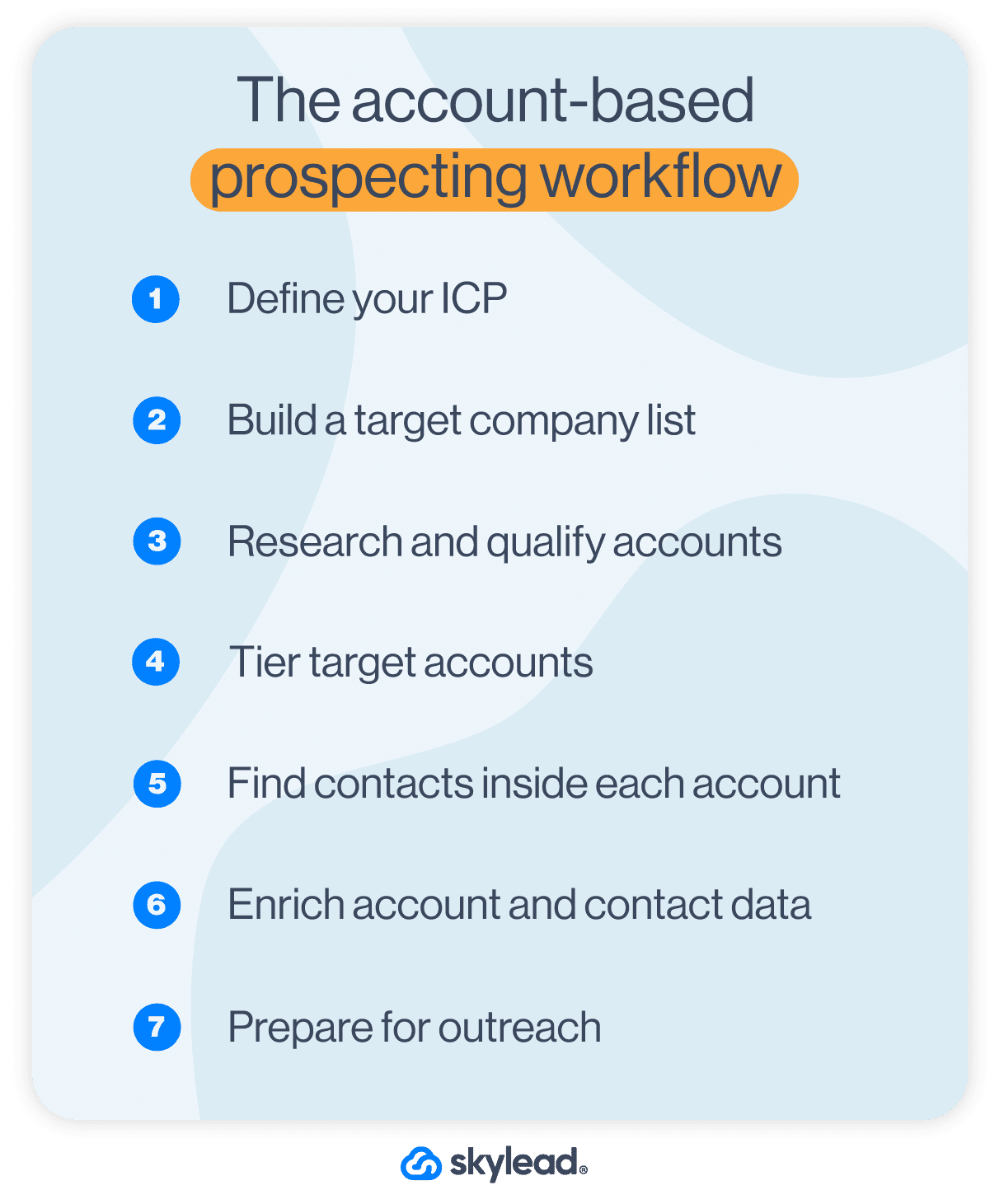
1. Define your ICP
You can’t find the right accounts if you don’t know what ‘’right’’ means.
And that’s why ABP starts with defining your ideal customer profile, or ICP. This is the type of company that is the best fit for your product, has the highest chance of converting, and is most likely to see real value from what you offer.
To define it, look at your best existing customers and search for patterns across criteria such as:
- Industry
- Company size
- Location
- Revenue
- Team size
- Growth stage
- Tech stack
- Use case
- Pain points
- Average deal size
- Sales cycle length
The goal is to understand what your best accounts have in common, so you can find more of those that look like them.
2. Build a target company list
Once your ICP is clear, it’s time to build your target company list. This is where the account-first part of ABP really kicks in. Rather than searching for individual prospects right away, you search for companies that match your ICP criteria.
You can build this list using:
- LinkedIn Sales Navigator account search filters
- Your CRM
- Website visitor data
- Funding databases
- Job boards
- Industry directories
- Intent data tools
- Competitor customer lists
- Your existing customer lookalikes
At this stage, don’t worry about finding every person inside the companies yet. Just focus on the companies themselves.
If Sales Navigator is the base for your search, we’ve got just the tool to help you put ABP into motion: Skylead.
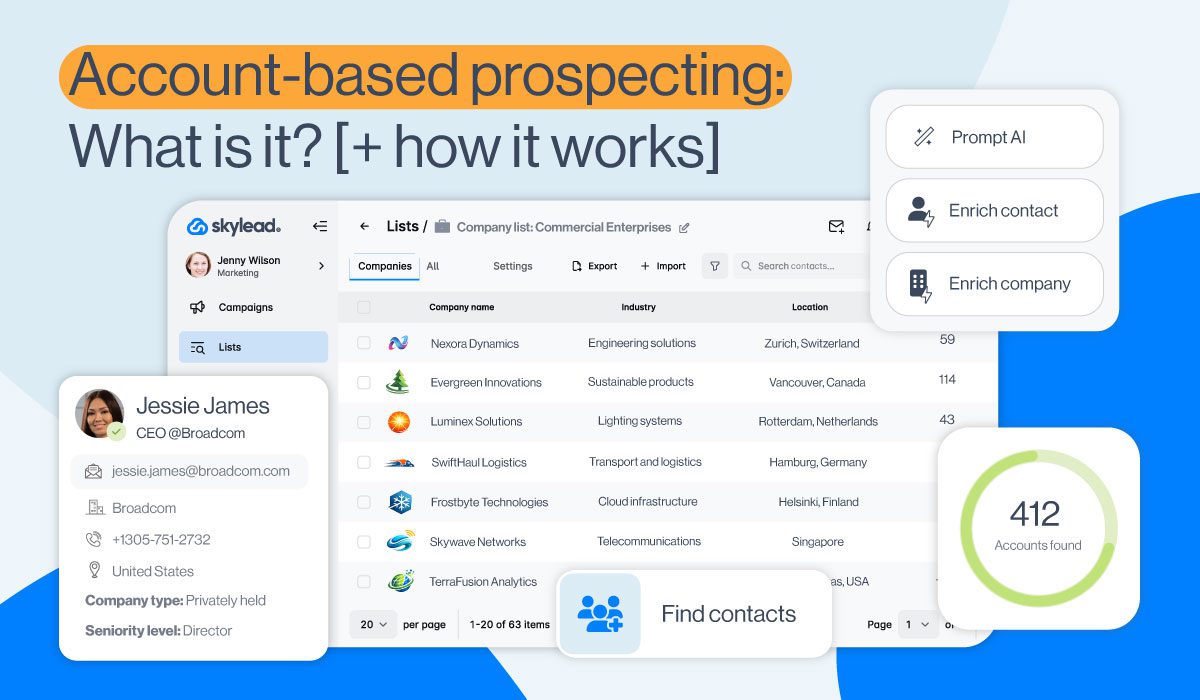
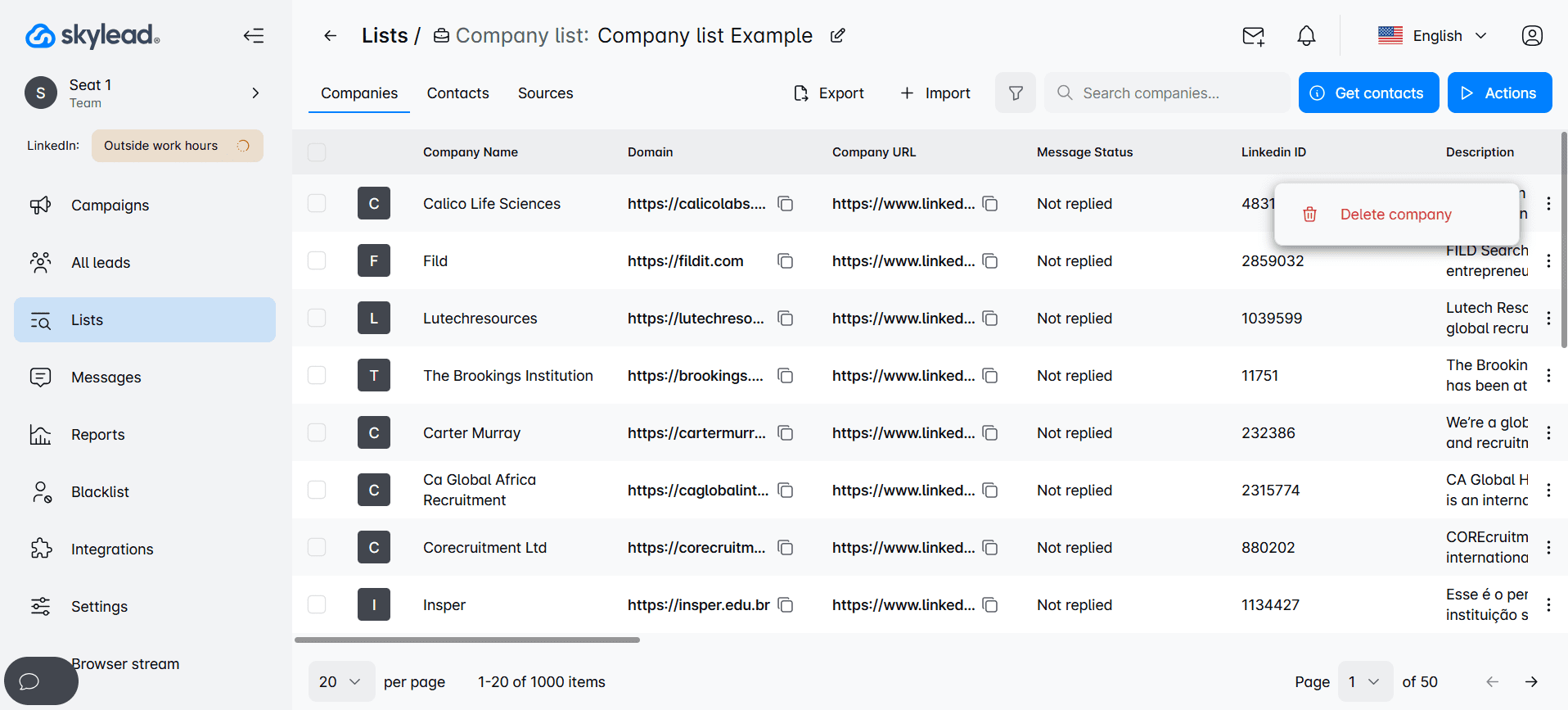
Skylead is an AI account-based sales engagement platform that doubles as a LinkedIn automation tool and cold email software. And guess what? It comes with an account-based prospecting feature that helps you build targeted contact lists from Sales Navigator search URLs.
The way it works is, you first apply Account filters to your Sales Navigator search using your ICP criteria and copy the URL.

Then, you paste it into Skylead.

From there, Skylead scans the results and pulls all companies into a company list.
3. Research and qualify each account
Now comes the part that separates actual account-based prospecting from simply building any company list.
You need to research each account and qualify whether it’s truly worth your team’s time.
This means looking at account-level details like:
- What the company does
- How large of an opportunity it could be
- Whether they have a relevant pain point
- Whether they’re showing buying signals
- What tools they may already use
- Whether they recently raised funding
- Whether they’re hiring for relevant roles
- If they’re expanding into new markets
- Whether there are existing connections or warm paths into the account
This is where you start separating accounts that look good on paper from those that are actually good for business.
For example, a company may match your industry and size criteria, but if they don’t have the problem you solve, they’re not a strong target. On the other hand, a slightly smaller company that recently hired a new Vice President, opened several relevant roles, and uses a tool that pairs well with yours may deserve more attention.
That’s the whole point of this stage: not just finding accounts, but understanding which ones deserve priority.
Of course, you could go about this step manually, but Skylead also comes with a handy AI data enrichment add-on that helps you speed up the process.
For example, you can ask AI to analyze a company website and determine whether the company is B2B or B2C, product or service-based, part of a specific niche, showing funding signals, or matching any other qualification rule you care about.

Skylead will create new column(s), complete with results. You can then review the information and filter the list accordingly by deleting accounts you do not wish to target.
4. Tier your target accounts
Once you’ve researched and qualified your target companies, divide them into tiers based on fit, value, and priority.
For example:
- Tier 1 accounts are your highest-value, best-fit companies. They deserve deeper research, more stakeholder mapping, and highly personalized outreach once the time comes.
- Tier 2 accounts are strong-fit companies with good potential, but they may not require the same level of attention.
- Tier 3 accounts are still relevant, but they’re usually better suited for lighter research and more scalable outreach.
This helps you match effort to opportunity. Because if you treat every account like a Tier 1 account, you’ll burn too much time. But if you treat every account like a Tier 3 account, you’ll miss the strategic opportunities that deserve more attention.
5. Find the right contacts inside each target account
This is where contacts finally enter the picture. But notice the order: first the account, then the contact.
Once you know which companies are worth pursuing, you can start identifying the right people inside them. These are the people who either feel the pain, influence the decision, control the budget, evaluate the tool, or block the deal.
Depending on what you sell, that may include:
- CEOs or founders
- Department heads
- Revenue leaders
- Operations managers
- Tech evaluators
- End users
- Procurement contacts
At this stage, you’re still not reaching out. You’re identifying the people who matter so you can approach the account properly later.
Now, remember the company lists you can build through Skylead? Well, once you’ve cleaned them up, you can also use our tool to get contacts inside them.
Simply navigate to your list, and click ‘’Get contacts’’,

A pop-up will appear prompting you to enter a Sales Navigator lead search URL that you need to filter according to, say, a job title.

Skylead will then compare your lead search results with your company list and return contacts that match your company AND contact criteria.
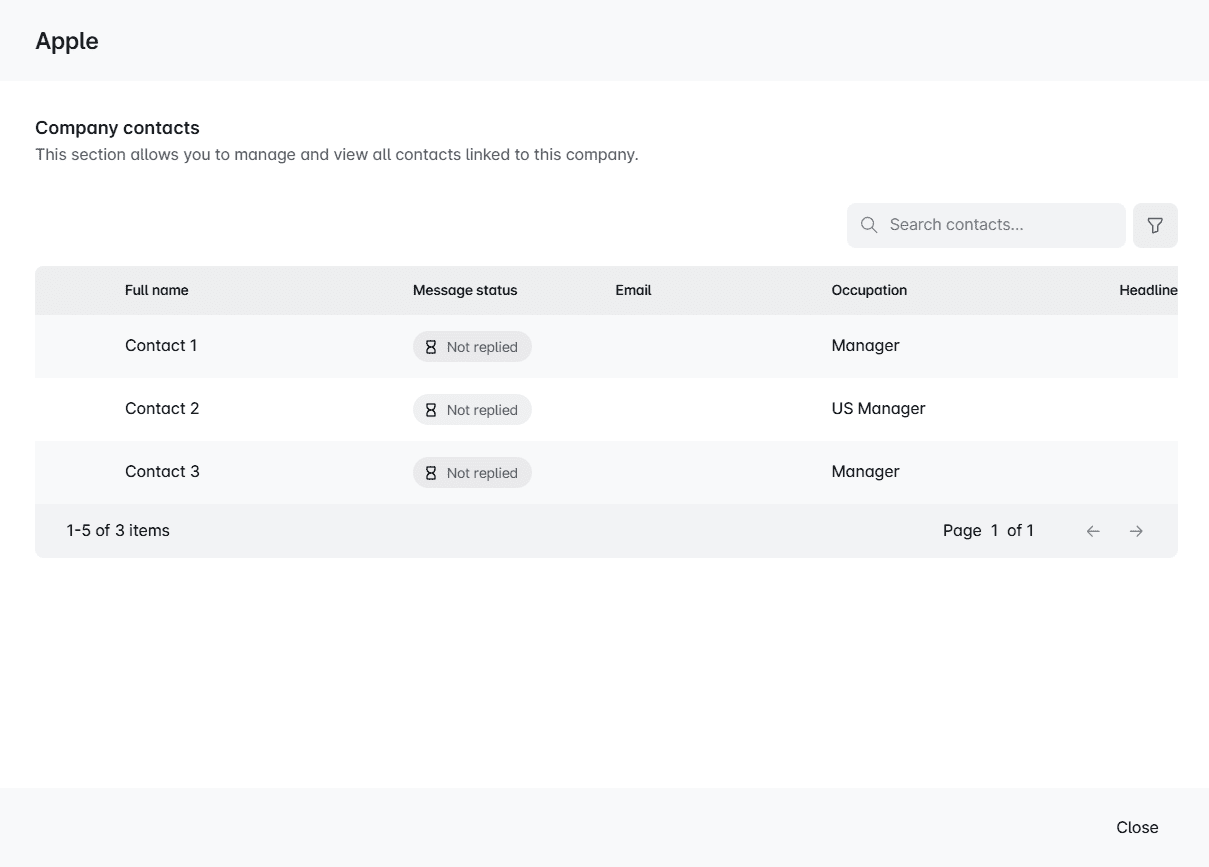
Yes, it’s that easy. 🙂
6. Enrich account and contact data
Once you have your company list and relevant contacts, enrich the data before moving into outreach.
This step helps you add the context you’ll later use to personalize messaging and prioritize accounts.
For example, you can enrich data around:
- Company overview
- Current role
- Skills
- Recent company news
- Open jobs
- Funding
- Growth signals
- Tech stack
- Lead background
… and much more!
The more context you have, the easier it becomes to understand why the account matters and how to approach the people inside it.
We already talked about using Skylead’s AI data enrichment add-on to get relevant account-level data. You can also use it to enrich contacts within them using details like:
- Bio
- Role
- Skills
- Experience
- Education
- LinkedIn posts
You can also use Prompt AI to describe exactly what you want to find or generate personalized icebreakers, then add the collected insight as a new column for easier use in an outreach campaign.
7. Prepare the account for outreach
At this point, account-based prospecting has done its job. You know which companies are worth pursuing. You know why they’re a fit. You’ve identified the right people inside them. You’ve gathered context that can support future messaging.
Only now does the outreach begin.
That could mean sending emails, LinkedIn connection messages, and LinkedIn inMails, making calls, or combining multiple outreach actions and channels into an automated sequence.
If you’re using Skylead, this transition is pretty straightforward.
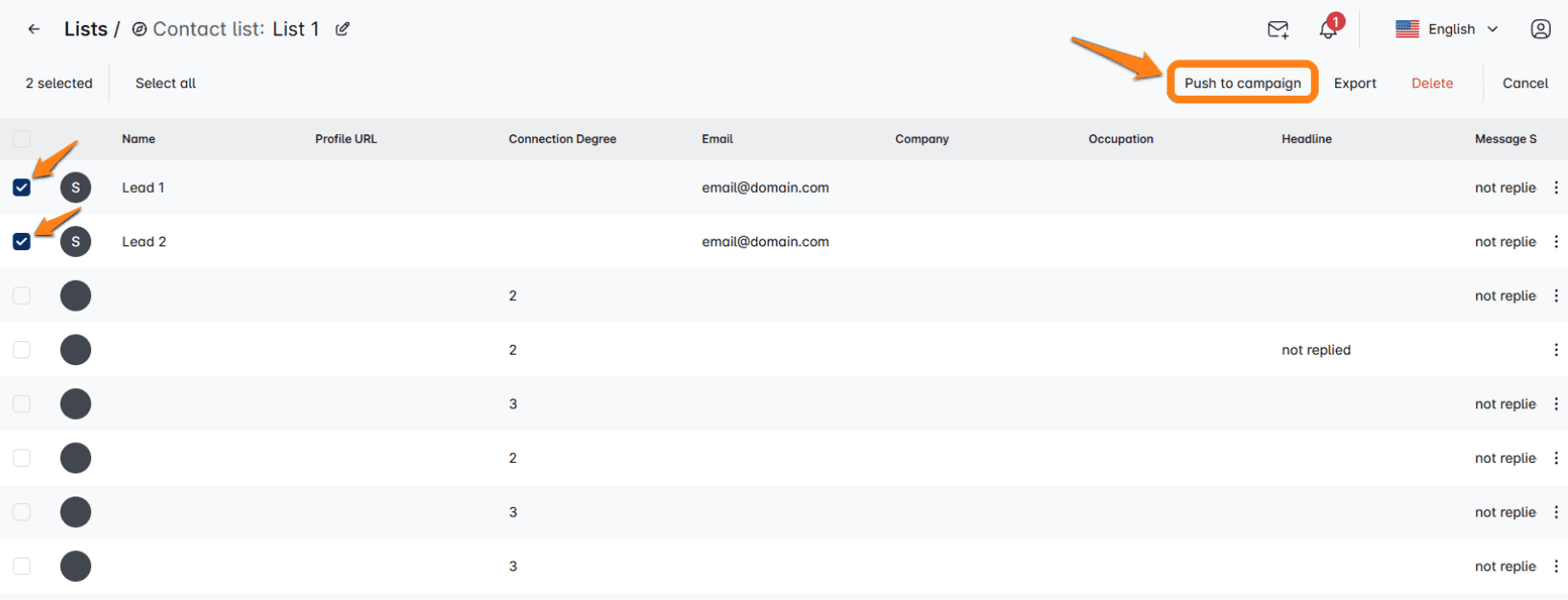
Once your contacts are matched with target accounts and enriched with the right context, you can push them directly into your campaign, a.k.a. Smart sequence.
The steps in a sequence will unfold according to the prospects’ behavior to help you maximize touchpoints and reach them, one way or the other.
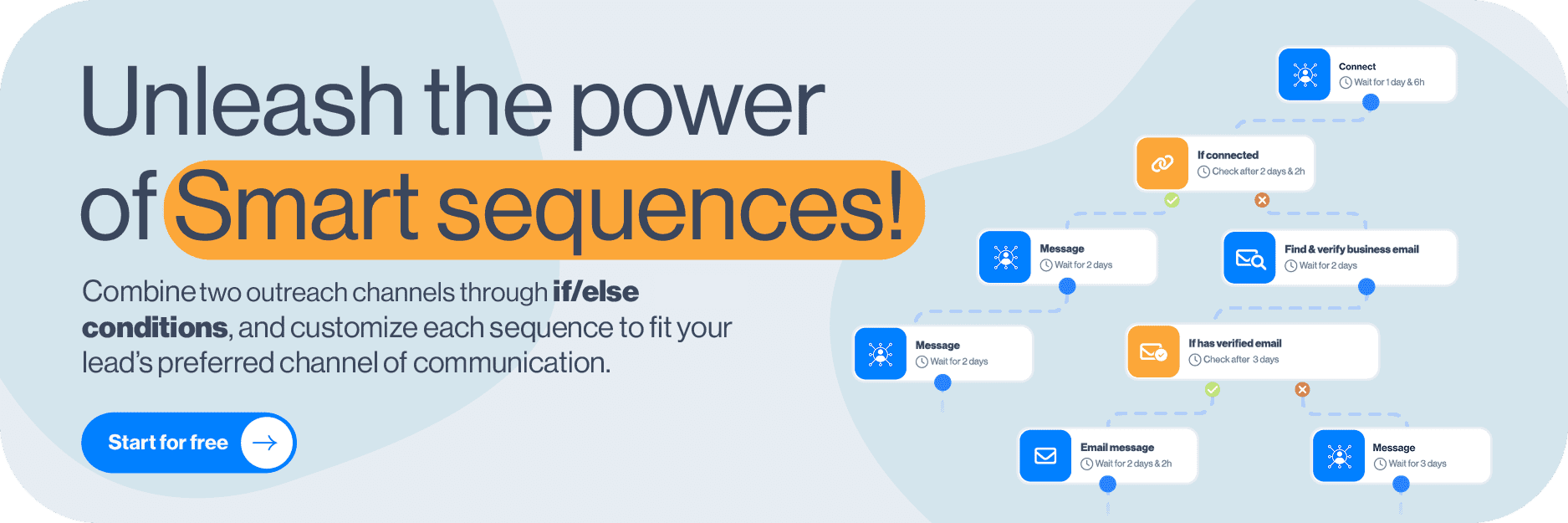
So, as you can see, not only does Skylead help you prospect. It also helps you enrich data and, finally, outreach. Outreach with the right context backed by account research, account fit, and stakeholder mapping to bring the entire sales engagement process full circle.
Frequently asked questions
Is account-based prospecting the same as lead generation?
Not quite. Lead generation is the broader process of attracting or collecting potential buyers and reaching out to them, often as individual contacts. Account-based prospecting is more specific. It starts with finding companies that match your ICP, then identifying the right people inside them.
Is account-based prospecting the same as outreach?
No. Account-based prospecting happens before outreach. It’s the process of finding, researching, qualifying, and preparing target accounts. Outreach is what happens once you start contacting the people inside those accounts through cold email, LinkedIn, cold calls, and other means.
Who should use account-based prospecting?
Account-based prospecting is best for B2B teams that sell to high-value accounts that warrant longer sales cycles, or are targeting multiple decision-makers. It’s most useful if your team needs to focus on quality over quantity, build a cleaner pipeline, or avoid wasting time on companies that aren’t a good fit.
How many accounts should you target with account-based prospecting?
That depends on your team size, market, and average deal value. If your focus is enterprise sales, your list should be smaller and more focused because each account requires deeper research. If you’re targeting mid-market companies, you can usually work with a larger list, as long as every company still matches your ICP.
What do you need for account-based prospecting?
At a minimum, you need a:
- Clear ICP
- Target company list
- Way to research and qualify accounts
- Way to find relevant contacts inside those accounts
- Data enrichment for better context
- A dedicated platform for sales engagement to move on to outreach once prospecting is done
Can you do account-based prospecting manually?
Yes, but it’s not ideal. You can build company lists manually, research accounts one by one, find contacts and information about them through LinkedIn, and keep track of everything in spreadsheets. However, using B2B prospecting tools or top sales engagement platforms makes the process faster, cleaner, and easier to scale.
Start putting the accounts first
With all said and done, it’s clear that account-based prospecting is the way to prospect in 2026 and beyond. After all, why waste time chasing random prospects when you can focus on companies that actually need what you sell?
And with Skylead, the entire process becomes a whole lot easier.
You can build targeted company lists, qualify accounts with AI data enrichment, find matching contacts inside those companies, enrich contact data, and push everything into Smart sequences when you’re ready to start outreach.
So, instead of jumping between spreadsheets, enrichment tools, and outreach platforms, you can keep the entire workflow in one place.
Claim your 7-day free trial now and try it yourself!