What is a sales engagement platform? [ + 6 reasons to use one ]

Since you landed here, chances are you’ve been researching sales engagement platforms, trying to understand what they are and what they do. So, what is a sales engagement platform really?
On paper, it sounds simple - software that helps salespeople engage prospects. But in reality, it covers a lot more than just sending messages.
Modern sales teams juggle multiple prospects and channels simultaneously, dozens of daily follow-ups, not to mention endless admin work inside CRMs and spreadsheets. Without a system tying all of that together, conversations often fall through the cracks, outreach becomes inconsistent, and reps spend more time learning to use multiple new tools than they do selling.
That’s exactly the problem a sales engagement platform was built to solve.
That said, today, we’ll be breaking down what a sales engagement platform really is, its core features, how it works, and how it supports the entire sales engagement process. As a bonus, we’ll introduce you to one of the best such platforms on the market, so you can put what you've learned into practice. Spoiler alert -it’s Skylead. 😉
What is a sales engagement platform?
A sales engagement platform (SEP) is software that helps sales teams plan, manage, automate, and optimize every interaction with prospects and customers alike across the entire sales cycle.
It’s meant to replace multiple tools that these individuals typically use during the process, allowing them to:
- Build structured outreach sequences
- Automate follow-ups based on timing or prospect behavior
- Personalize messages at scale
- Track engagement signals like opens, replies, and clicks
- Prioritize prospects
- Reduce repetitive work
… and more!
Sales engagement platform vs. sales enablement platform vs. CRM
These 3 tools often get lumped together. In reality, they serve very different purposes in the sales stack.
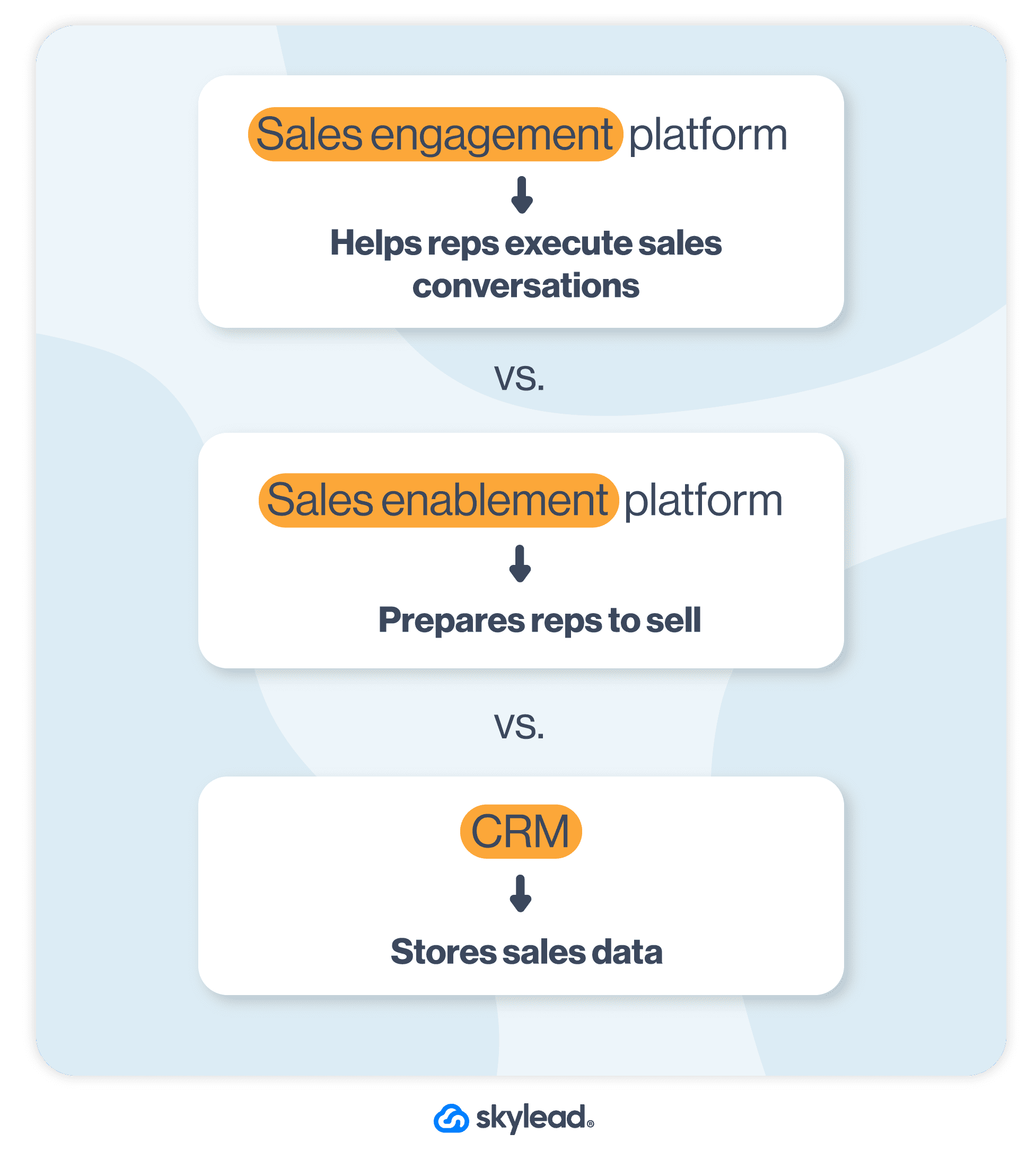
Now, let’s dig a little deeper into what each one does to understand what a sales engagement platform is really and how it differs from these two.
CRM
A customer relationship management software or CRM is your system of record, so to speak. It stores contacts, accounts, deals, and activity history and is meant to help you track deal stages and pipeline, forecast revenue, and keep customer data organized.
Popular examples include HubSpot, Salesforce, Pipedrive, and Zoho CRM.
In other words, CRMs show you where deals are, but even the best CRM software for sales doesn’t do much in terms of moving them forward.
Sales enablement platforms
On the other hand, sales enablement platforms focus on preparing reps to sell more effectively, with the highly regarded options being Seismic, Showpad, and Gong.
They typically provide training and onboarding materials, sales content libraries that include case studies, decks, and other materials created in collaboration with the marketing team, as well ascoaching resources, objection handling techniques, and playbooks.
Their job is to make sure reps have the right knowledge and content at their fingertips, so that, when the time to sell actually comes, they’re fully prepared. They stop short of execution, though.

Sales engagement platforms
And that brings us to the sales engagement platforms.
We previously talked about what sales engagement is, and then, we said it’s the ‘’execution layer’’ of the sales process where conversations with the prospects finally happen.
Now, don’t get me wrong, sales engagement can absolutely happen without a tool. But doing it manually means juggling inboxes, setting calendar reminders for follow-ups, updating the CRM after every interaction, and trying to remember who opened what and when. That might work with 20 prospects. With 200, however? Not so much.
In such situations, you need a sales engagement platform - a system that makes sales engagement at scale possible. It structures, automates, and tracks how reps interact with prospects across channels, so execution becomes consistent instead of reactive.
To make the distinction crystal clear:
- CRMs store customer information and record what happened.
- Sales enablement platforms prepare reps for conversations.
- Sales engagement platforms help execute those same conversations.
So, as you can see, SEPs don’t just store data or provide content. They drive action.
Who are sales engagement platforms for?
Contrary to popular opinion, SEPs aren’t built for SDRs only.
Rather, they are built for anyone looking for a consistent way to engage prospects at scale while keeping things personal.
In terms of specific roles, that usually includes:
- SDRs / BDRs handling high-volume outbound who need structured sequences, automated follow-ups, and clear signals on who to prioritize next.
- Account executives (AEs) managing active deals who want one place to track conversations, stay on top of stakeholders, and move opportunities forward faster.
- Sales managers requiring visibility into rep activity, engagement quality, and pipeline momentum.
- RevOps / Sales Ops teams responsible for process consistency, tooling, and reporting across the funnel.
But roles aside, sales engagement platforms are especially valuable for those who:
- Work with high lead or account volume
- Sell across multiple channels
- Want predictable execution
- Care about scaling cold outreach
- Need real engagement data to improve performance over time
Benefits of using a sales engagement platform
According to industry data, the vast majority of sales organizations have adopted or plan to adopt engagement platforms because they:
- Give reps tools to focus on selling rather than completing repetitive tasks
- Standardize best practices across teams
- Make engagement measurable and repeatable
- Enable faster ramp-up for new hires
- Provide actionable signals on prospect behavior
All of this adds up to higher conversion rates, faster cycles, and more predictable sales performance than teams using disconnected tools.
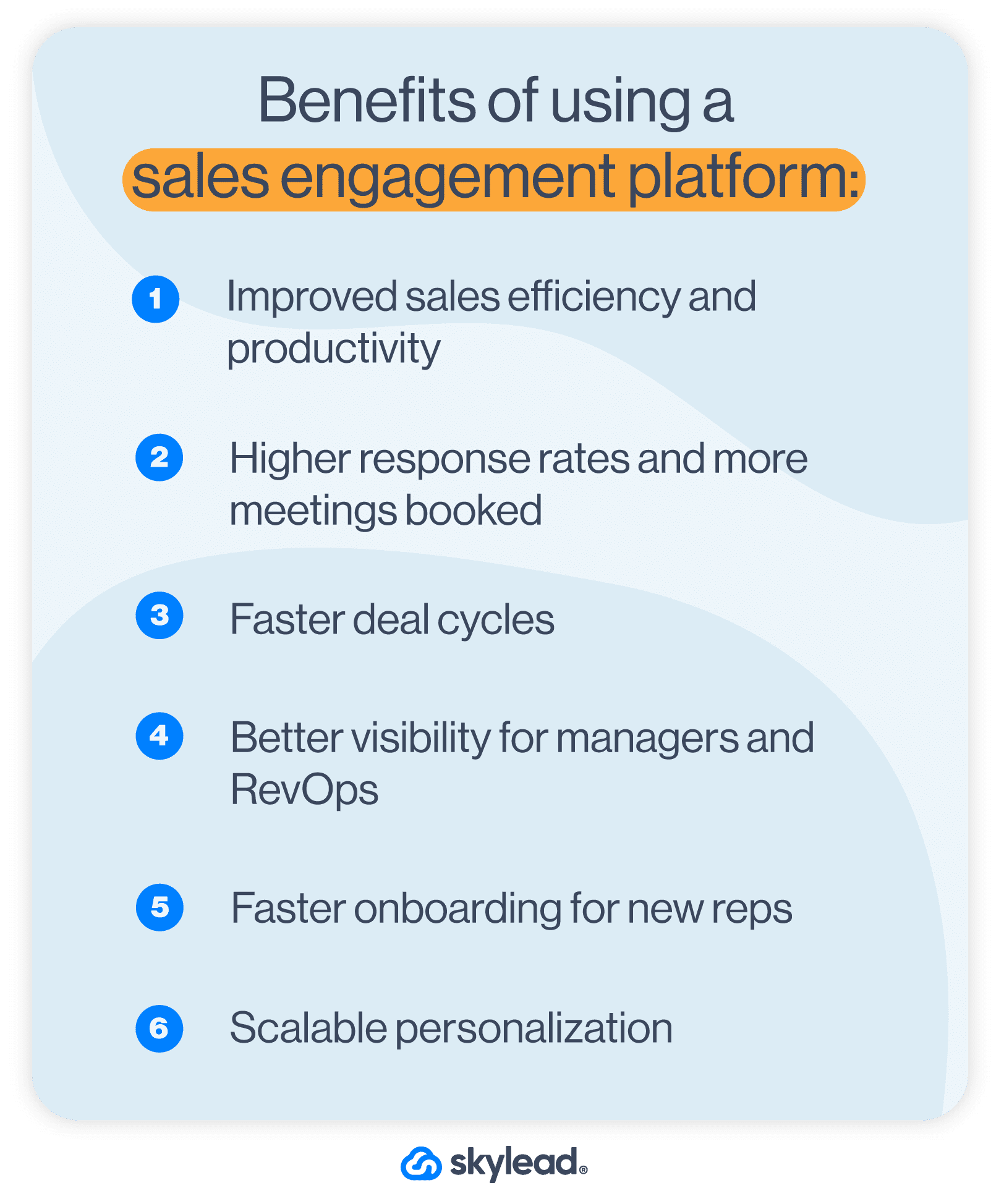
That said, let’s get into the individual benefits of using SEPs so you fully understand why you need one.
Improved sales efficiency and productivity
Sales reps spend far less time selling than most teams realize. Multiple studies show that reps typically spend only 28% of their week on actual sales activities, with the rest going to admin, internal meetings, and tool-hopping.
Sales engagement platforms tackle this head-on by automating repetitive work like follow-ups, activity logging, and meeting scheduling. Teams using SEPs consistently report double-digit increases in rep productivity, simply because sellers stop wasting hours on manual tasks and start their day with a clear, prioritized action list.
Higher response rates and more meetings booked
Outbound campaigns that use structured sequences across multiple channels (email + calls + social) generate up to 4-5 times higher engagement compared to single-channel outreach. And teams using automated sequences typically see 40% higher reply rates than those relying on manual follow-ups.
Why?
Because with SEPs:
- Every prospect gets contacted at the right time
- Follow-ups actually happen
- Messaging stays consistent
- Engagement signals trigger the next step automatically
Instead of guessing who to contact next, reps act on real behavior: opens, clicks, and replies.
Faster deal cycles
Deals slow down when momentum drops. Sales engagement platforms help prevent that by keeping prospects warm throughout the buying journey. Organizations using SEPs commonly report shorter sales cycles (often by 10-20%), simply because conversations don’t slow down and stakeholders don’t get forgotten.
Better visibility for managers and RevOps
Without an SEP, managers rely heavily on CRM data that’s often incomplete or outdated.
With a sales engagement platform, though, activity tracking happens automatically. That gives leadership visibility into:
- Which reps are engaging accounts
- Which sequences perform best
- Where deals are dropping off
- How prospects respond
This leads to stronger coaching, cleaner forecasting, and faster process improvements - all based on real data instead of assumptions.
Faster onboarding for new reps
New hires usually struggle with 2 things: knowing what to do and when to do it.
SEPs solve both.
By providing ready-made sequences and workflow templates, new hires can start executing proven plays from day 1. Many teams report significantly shorter ramp-up times because beginners don’t have to invent their own process - they simply follow what already works.
Scalable personalization
Sales engagement platforms make it possible to keep the sales outreach relevant while working with hundreds of prospects at once. Reps write the core message, while the platform handles personalization, timing, sequencing, and delivery.
That’s how teams maintain a human touch without slowing down.
Key features of sales engagement platforms
At their core, sales engagement platforms are built to help users run targeted outreach, follow up on time, and maintain consistent communication with prospects, without juggling five different tools at the same time.
While every platform looks a little different, most SEPs share the same core building blocks.
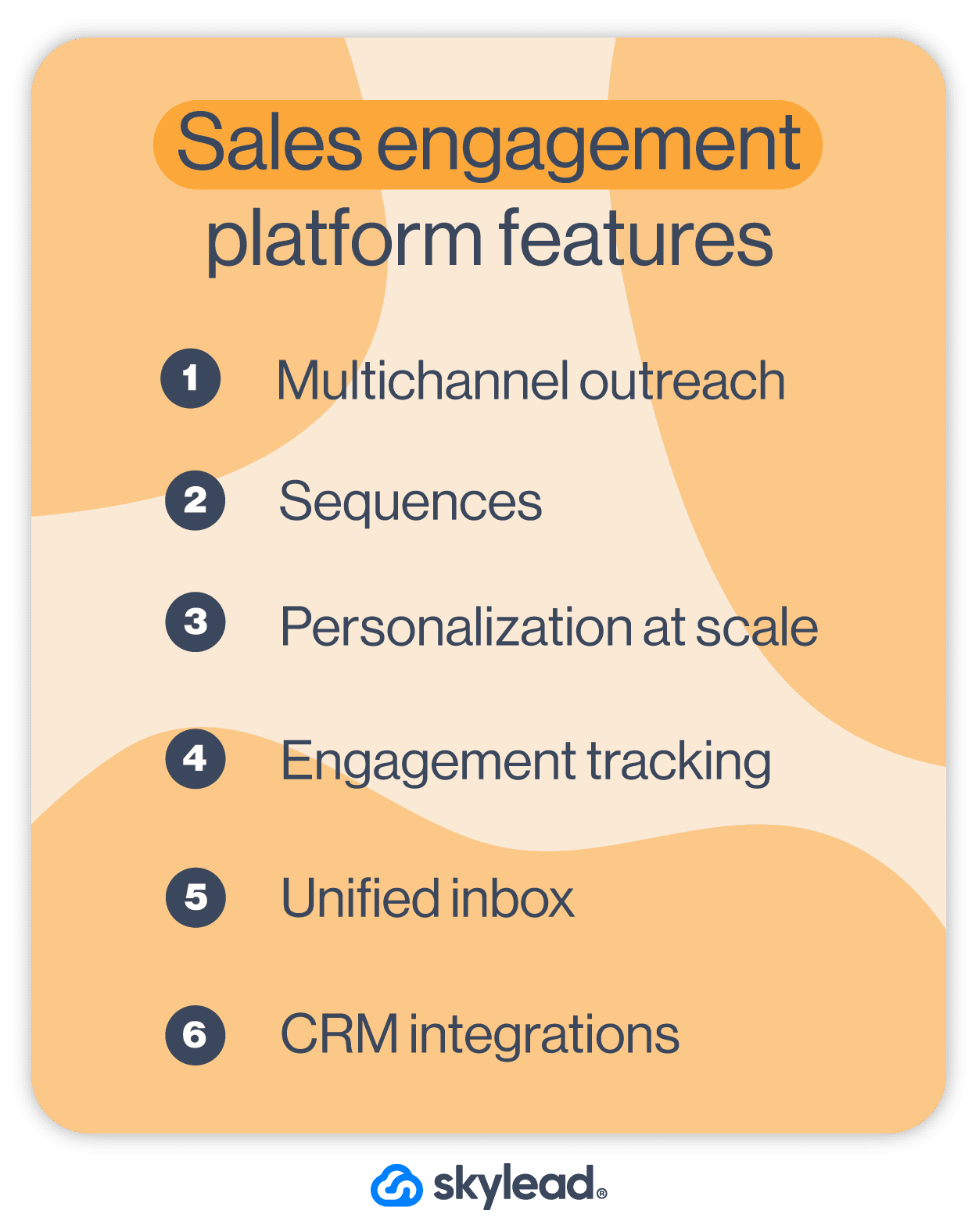
1. Multichannel outreach
Modern buyers don’t use one platform only, meaning that to actually get to them, deals require multiple touches across different channels. This is confirmed by stats, too, which suggest that it takes an average of 8 touchpoints to close a prospect. Or, as Jeb Blount explains in his book, Fanatical Prospecting, even up to 50 touchpoints if they are unfamiliar with your brand.
Now, imagine if you sent 50 emails to the same person. That would be... a lot, to say the least. It would also be a massive waste of time if it happens your prospects are inactive on email.
Now, pair that with touches on social media, particularly a platform they are active on, and up go your chances of getting a response.
Of course, you don't have to go about multichannel outreach manually. The good thing about sales engagement platforms is that they let users reach prospects across different channels, all within one sequence. So, if, say, a prospect is silent on one channel, the tool goes straight to the next.
2. Sequences
Sequences (or cadences, depending on the tool) are the backbone of any SEP.
They allow you to map out your outreach once, then reuse it across hundreds of prospects.
A typical sequence might include:
- an initial email
- a follow-up email after no response
- another email a few days later
- a message on social media
Once launched, the sequence unfolds either depending on the prospect’s behavior (in more advanced cases) or the time delay set between outreach actions.
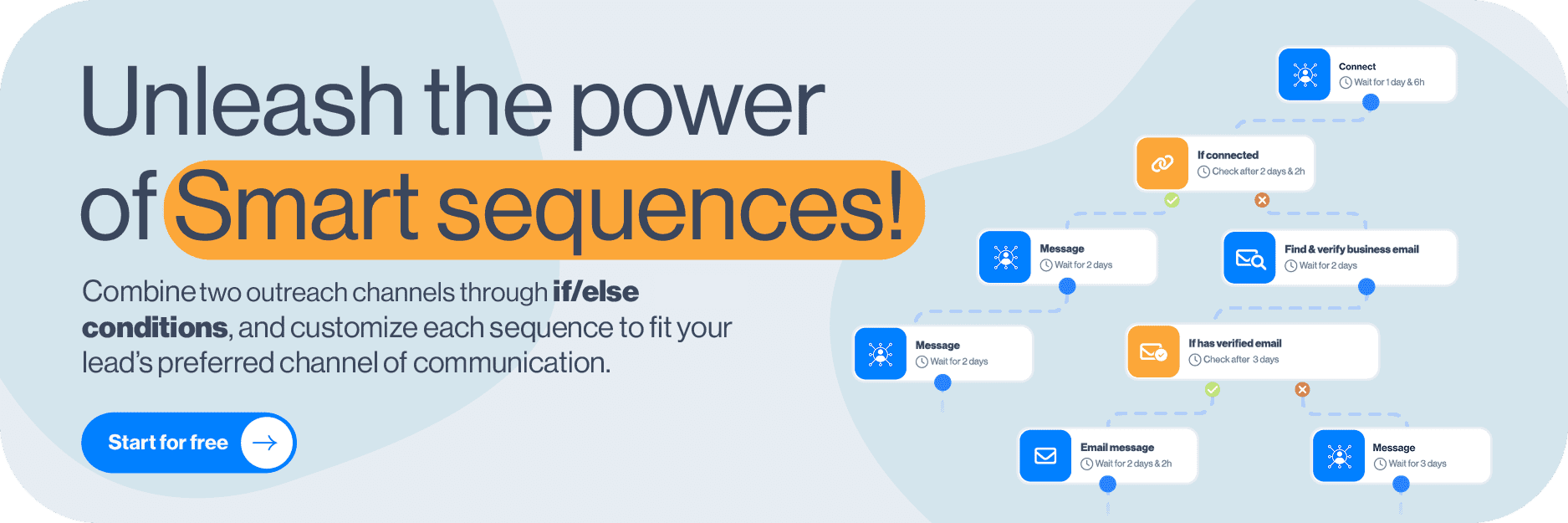
That said, Skylead, our very own AI account-based sales engagement platform, was the first on the market to introduce so-called Smart sequences - algorithms that combine outreach actions with if/else conditions. As a result, you get coherent outreach flows that respond to prospects’ behavior in real time to make the most of your touchpoints and reach them in the fastest possible way!
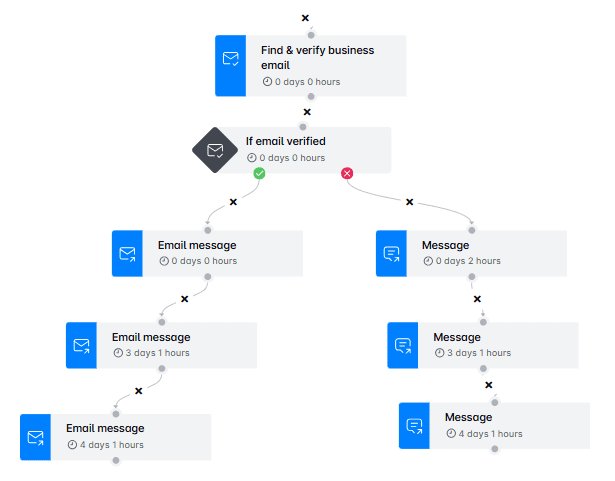
And if you rely on email outreach for the most part, you’ll be happy to know that:
- A: Not only can you connect unlimited mailboxes to your Skylead account and thus, send tens of thousands of emails a month to your prospects at no additional cost,
- B: You can also discover and verify your leads’ emails without breaking your outreach flow and thus, prevent bounces that hurt your deliverability and sender reputation.
3. Personalization at scale
Most SEPs allow you to personalize messages at scale using variables (a.k.a. merge fields) for details, such as first and last name, company name, role, industry, etc. Some, Skylead included, also let you import your own variables to personalize virtually any detail you like.
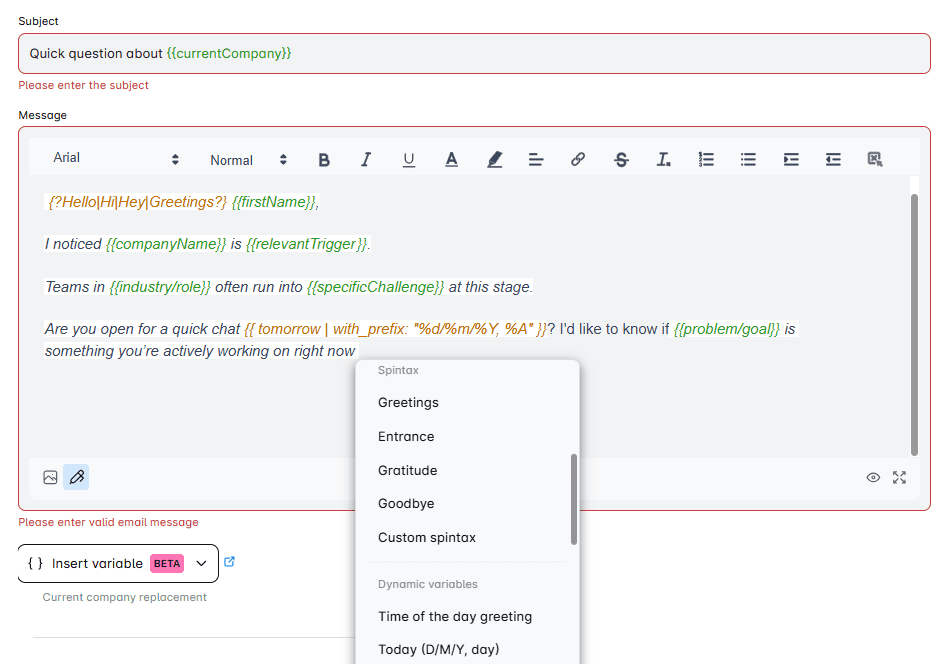
And speaking of Skylead, it comes with advanced personalization features, including:
- Spintax, which lets you rotate phrase variations (such as hi, hey, hello).
- Liquid syntax, which combines variables and conditions to show different content to different prospects based on predefined rules.
- Image and GIF personalization that lets you personalize visuals with text and variables, as well as your own and your prospects’ profile images and company logos.
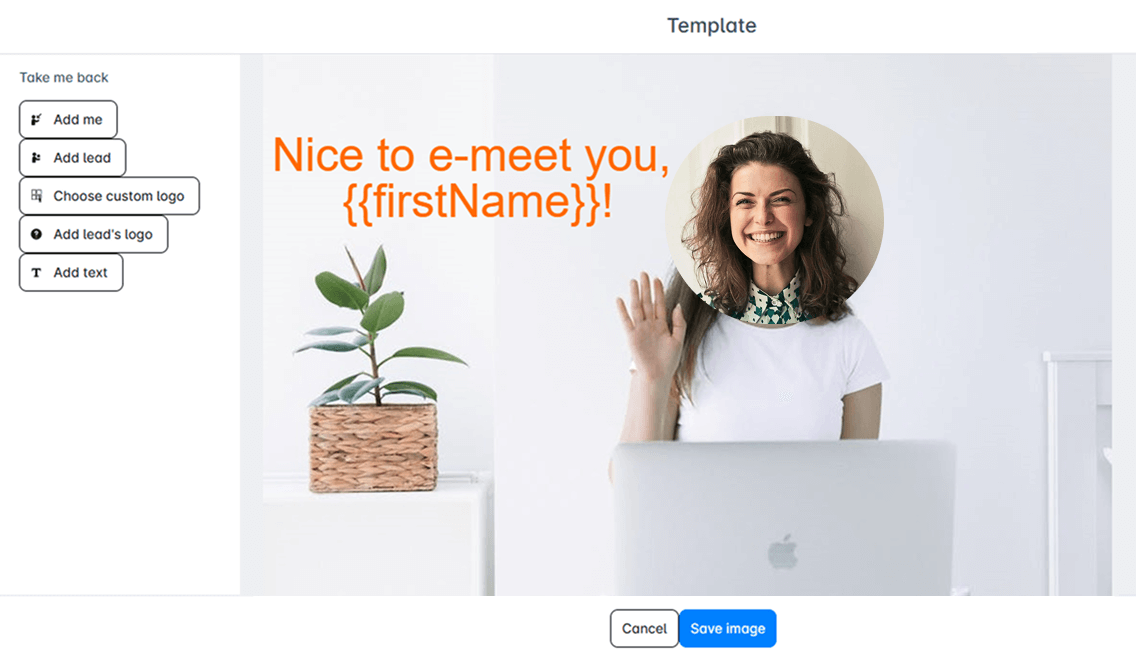
As a result of this combination, you get fully personalized outreach that feels absolutely human and gets you up to 76% increase in response rate!
4. Engagement tracking
Sales engagement platforms don’t stop at sending messages. They also track what happens after these are sent.
That might include:
- email opens
- link clicks
- replies
- social media profile views
- social media connections
… and more, depending on the platform.
These signals help users spot interested prospects faster and stop wasting time on accounts that aren’t engaging.
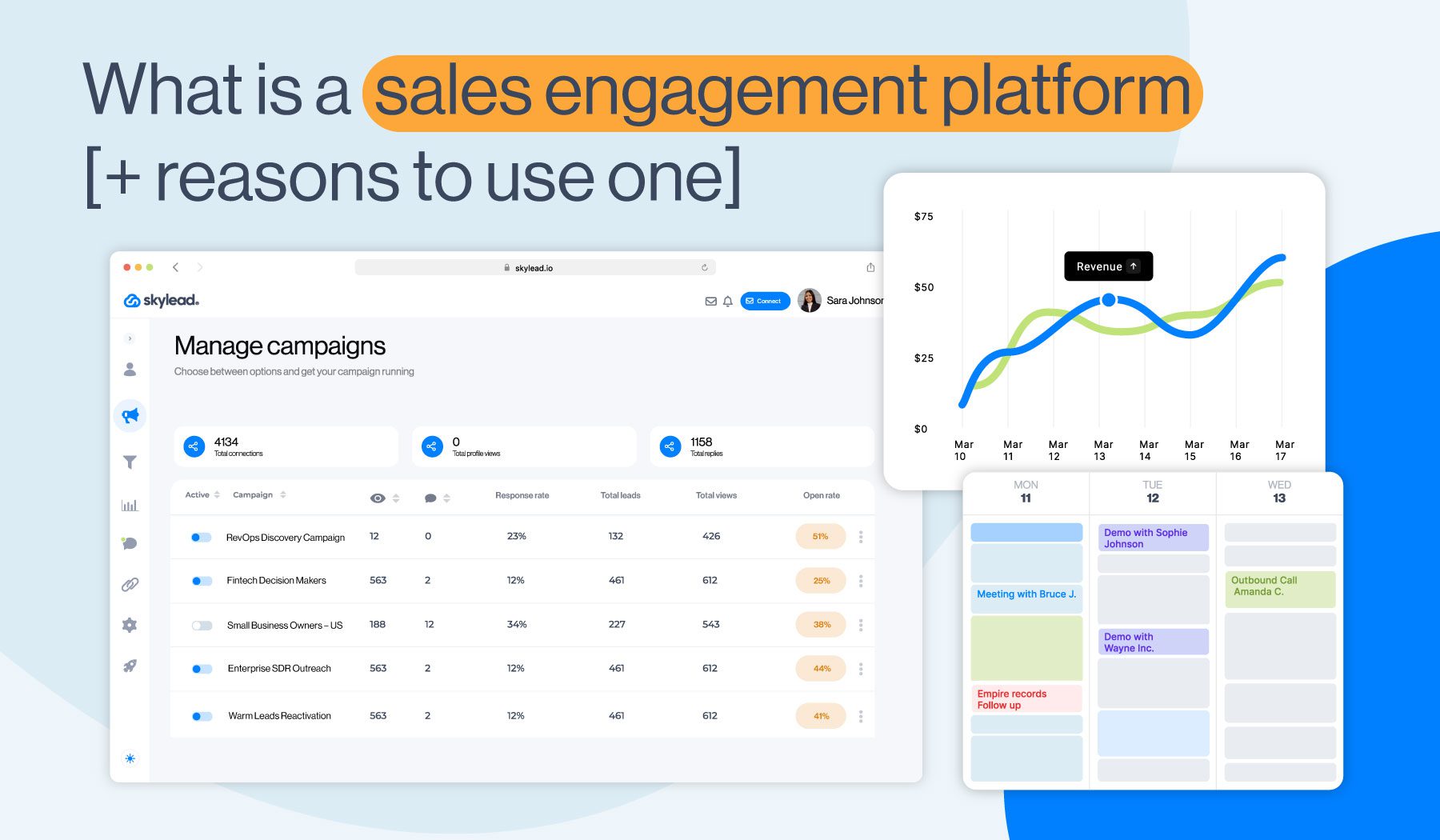
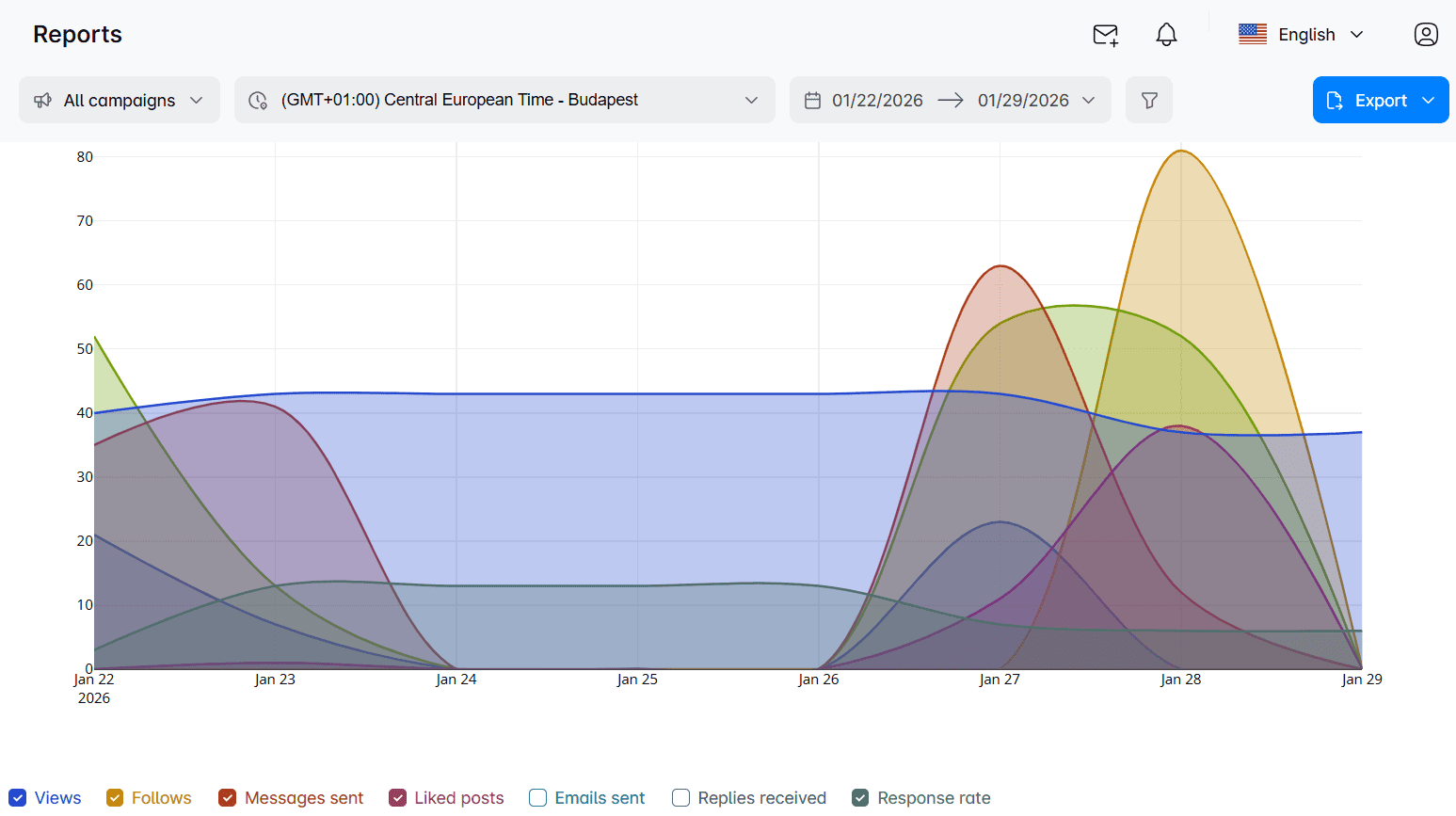
To paint a better picture, Skylead comes with a dedicated Reports page where you can analyze the performance of your Smart sequences in 3 different view modes:
- Graph, where you can easily observe oscillations.
- Table, to track day-by-day performance.
- Step-by-step, to examine the performance of individual steps in a sequence. This is particularly useful if running A/B tests, as you can compare up to 5 message variants side by side.
5. Unified inbox
Most sales teams still manage conversations across multiple places: Gmail, social media, CRM notes, and maybe even Slack. That fragmentation slows things down and makes it harder to keep context.
That’s why most sales engagement platforms include a unified inbox that pulls all prospect conversations into one place. Emails and all social replies sit side by side, so users don’t have to jump between tools just to answer a message.
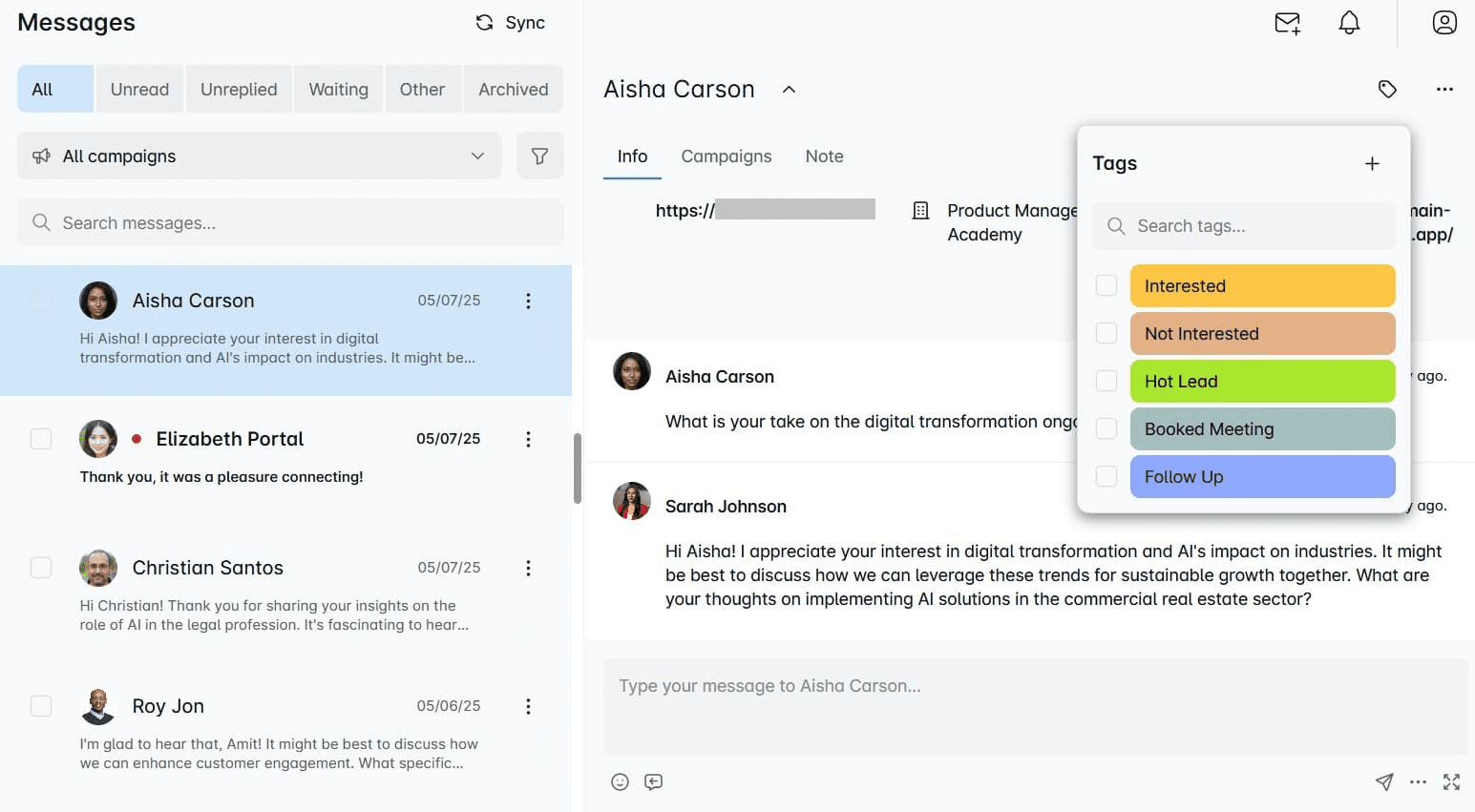
With Skylead, this comes in the form of a Smart Inbox.
It holds your entire correspondence with prospects, regardless of channel. You can reply directly from it, leave internal notes on specific leads, and add tags to track things like meetings booked, conversions, or deal status. Everything stays connected to the outreach sequence (a.k.a. campaign), so you always know what happened before responding.
6. CRM integration
You know what a sales engagement platform is already, and that it’s different from a CRM. It’s also not supposed to replace one. Rather, it’s meant to work alongside it.
For that reason exactly, the best sales engagement platforms must integrate with CRM.
A good SEP automatically syncs activity like emails sent, replies received, etc., back to your CRM. This keeps customer records up to date without forcing users to log every interaction manually.
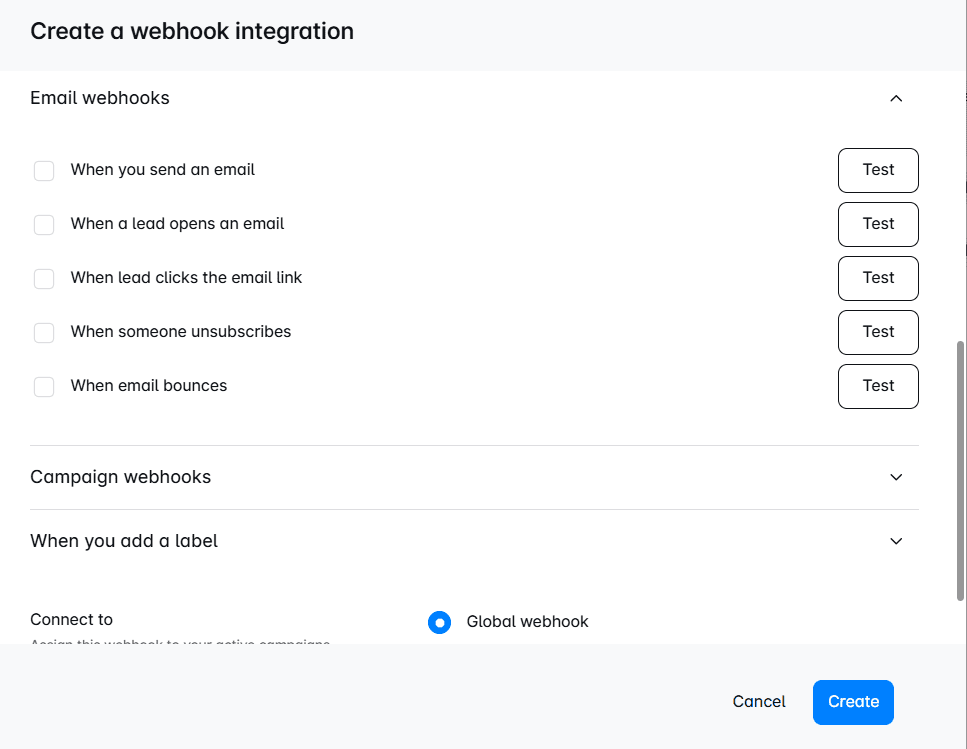
Skylead integrates directly with popular CRMs like Salesforce and Pipedrive. And if your tech stack looks a little different, you can still connect Skylead to virtually any CRM or internal tool through webhooks or API.
How to choose the right sales engagement platform
By now, you know what a sales engagement platform does and which features matter. The next question is obvious: how do you actually pick the right one?
Because while most SEPs look similar on the surface, they’re very different once you start using them day to day.
Here’s what we recommend focusing on.
1. Start with your sales motion
Before comparing tools, get clear on how your team sells.
Ask yourself:
- Are you running high-volume outbound outreach or account-based outreach?
- Do reps work mostly over email, social, or both?
- Are you focused on prospecting, deal acceleration, or both?
Some platforms are built mainly for SDR-heavy outbound. Others shine in account-based sales. A few handle both well.
If the platform doesn’t match your actual workflow, no feature list will save it.
2. Look for workflow flexibility (not just automation)
Automation alone isn’t enough.
What you really want is flexibility: the ability to adjust outreach based on prospect behavior, change paths mid-sequence, and personalize without breaking your flow.
Static cadences are fine for basic use cases. But if you care about timing, intent, and real engagement, make sure the platform supports behavior-based logic, not just fixed delays.
3. Make sure you will actually use it
If users find the platform clunky, slow, or confusing, adoption drops. And once adoption drops, your ROI disappears.
Pay attention to:
- How intuitive the UI feels
- How many clicks it takes to launch an outreach campaign
- Whether daily tasks are clear and prioritized
- How easy it is to reply, personalize, and adjust sequences
A sales engagement platform should simplify your day, not add another layer of friction.
4. Check CRM sync quality
Almost every SEP claims CRM integration. That doesn’t mean they all do it well.
What you want is:
- Automatic activity logging
- Clean contact and account syncing
- Reliable status updates
- Minimal manual cleanup
If you still have to update the CRM by hand, you’re missing half the value.
5. Prioritize engagement data and reporting
Make sure the platform gives you clear visibility into messages sent, replies, and clicks, and sequence performance as a whole.
This is what allows managers to coach effectively and RevOps to optimize processes based on reality, rather than assumptions.
6. Think about scale
You might be a team of 3 now. That doesn’t mean you’ll stay that way.
Look for a platform that can grow with you, meaning it supports:
- Multiple seats
- Unlimited mailboxes
- High message volumes
- Deep personalization
- Complex workflows
Switching SEPs later on is painful. So, choosing one that supports growth saves you from rebuilding your entire outreach stack down the line.
At the end of the day, the best sales engagement platform isn’t the one with the longest feature list.
It’s the one that fits your sales motion, removes manual work, gives you clean performance data, and helps your team execute consistently.
Common myths about sales engagement platforms
Sales engagement platforms are everywhere now. And with popularity comes… confusion.
Over the years, our sales team at Skylead has noticed a few recurring myths that stop teams from adopting SEPs or using them properly.
That being said, we had them list the most common objections they hear, so we can, once and for all, bust all the myths.
Myth #1: It’s just an email automation tool
This is the most common one.
Yes, SEPs send emails. But if that’s all they did, they wouldn’t deserve their own category.
A true sales engagement platform structures multichannel outreach, tracks engagement signals, prioritizes prospects, syncs activity to CRM, and creates repeatable workflows across the entire funnel.
Email automation is a feature. Execution management is the real value.
Myth #2: Only SDR teams need it
Sales engagement platforms are often associated with high-volume outbound. And while SDRs benefit massively from structured sequences and automated follow-ups, they’re not the only ones.
Account executives use SEPs to:
- Keep multi-threaded deals organized
- Follow up consistently with stakeholders
- Maintain momentum in longer sales cycles
Meanwhile, managers use them for visibility, whereas RevOps uses them for process standardization.
And honestly, execution consistency benefits the whole team, not just the top of the funnel.
Myth #3: It will make outreach robotic
This fear is understandable. After all, bad automation does feel robotic.
On the other hand, good automation feels structured.
Modern SEPs allow:
- Variables and conditional messaging
- Behavior-based follow-ups
- Channel switching based on engagement
- A/B testing for continuous improvement
So, if your outreach sounds robotic despite using a modern sales engagement platform, sorry to break it to you, but that’s not a platform problem. It’s a messaging problem.
Myth #4: Our CRM already does this
CRMs are built to store data. They are not built to manage complex outreach workflows, automate multi-step sequences, or trigger actions based on engagement behavior.
Some CRMs offer basic sequencing. But they rarely provide the flexibility, reporting depth, and execution control of a dedicated sales engagement platform.
Not to mention, if you still rely on calendar reminders and manual follow-ups, your CRM isn’t solving the execution problem.
Myth #5: It’s too advanced for small teams
This one actually works the opposite way, as small teams benefit the most from structure.
When you don’t have 10 reps, you can’t afford dropped follow-ups, inconsistent messaging, or stalled deals.
In this case, a sales engagement platform doesn’t add complexity. It removes chaos. And it gives small teams the ability to operate like larger, more mature organizations, without hiring extra people.
Frequently asked questions (FAQs)
What does sales engagement mean?
Sales engagement refers to all interactions between sales reps and prospects across the buying journey. This includes emails, calls, social touches, follow-ups, and meetings. The goal is to keep communication consistent, relevant, and timely so deals move forward.
What is the difference between a CRM and a sales engagement platform?
A CRM stores and organizes customer data, tracks deal stages, and supports forecasting. A sales engagement platform manages outreach execution. It structures sequences, automates follow-ups, and tracks engagement. In short, the CRM records what happened, while the SEP drives action.
Do sales engagement platforms replace a CRM?
No. Sales engagement platforms are designed to work alongside a CRM, not replace it. The CRM remains the system of record for pipeline and forecasting, while the SEP manages outreach workflows, follow-ups, and engagement tracking.
Are sales engagement platforms only for outbound sales?
No. While they are widely used for outbound prospecting, sales engagement platforms also support inbound follow-ups, deal acceleration, renewals, and multi-stakeholder communication. Any sales motion that depends on timely, structured engagement can benefit from an SEP.
What does the future hold for sales engagement platforms?
Sales engagement platforms are evolving toward AI-driven execution and deeper data integration. Future SEPs will prioritize buying signals, suggest next best actions, and unify account-based prospecting, outreach, conversation data, and CRM syncing. The focus is shifting from basic automation to intelligent workflow orchestration across the entire sales cycle.
From understanding sales engagement to actually executing it
With everything said and done, it’s time to give the straight answer to the original question: what is a sales engagement platform?
Sales engagement itself is the execution layer of the sales process. A sales engagement platform is the system that supports that same execution at scale.
It gives your team the structure and, of course, the tools to turn strategy into action by organizing outreach, automating follow-ups, tracking engagement signals, and keeping every prospect conversation in one place.
But the real question now is: do you want your team relying on a hunch or on a system that actually supports consistent execution?
If the latter is your answer, Skylead is the sales engagement platform for you. It helps you run structured multichannel outreach, automate follow-ups based on real prospect behavior, and keep every conversation in one place - so you close 3x more deals while saving 11+ hours a week on repetitive tasks.
Try it free for 7 days to see how predictable, scalable sales engagement actually feels!